
Alex Slawson[*]
The artificial intelligence (AI) revolution could produce the next generation of innovative companies and products, just as the industrial and information revolutions before it. However, there is a risk that monopolists in incumbent technology markets—like those for semiconductors, cloud computing, and operating systems—will leverage their power to dominate the nascent market for AI services. If that happens, the winners of the AI revolution will not be the most innovative AI companies. Rather, they will be the companies that already dominate the upstream and downstream markets upon which AI depends. This Article analyzes that risk through the antitrust concepts of input and customer foreclosure. It discusses three types of anticompetitive conduct—refusing to deal, exclusive dealing, and tying—that are particularly threatening to the nascent AI market. It also proposes reforms to antitrust law that would help ensure a competitive, pluralistic AI economy.
Table of Contents
A. The Supply Chain for Compute
2. Refusals To Deal in the AI Supply Chain
C. Policy Proposals: Toward Compute Neutrality
1. Amending the Sherman Act for the AI age
2. Mandatory Disclosure of Training Results
4. Increased Scrutiny on Vertical Mergers
5. If All Else Fails: A Nationalized Compute Supply
A. The Market for AI Platforms
1. Overview of Exclusive Dealing Jurisprudence
2. Exclusive Dealing in the AI Market
1. Overview of Tying Jurisprudence
D. Policy Proposals: Toward a Neutral, Pluralistic Platform Market
2. Scrutinizing Platform Mergers
3. If All Else Fails: A Monopoly Tax
Introduction
Generative artificial intelligence,[1] like the popular ChatGPT, could revolutionize the economy.[2] But if the resulting economic bounty is to be enjoyed by the many, not just the very few, the markets for AI services must be competitive. If they are not, economic concentration, which is already significant, could reach unprecedented levels.[3]
Unfortunately for policymakers, some aspects of the AI market naturally tend toward concentration, even absent any anti-competitive behavior.[4] These aspects include:
- High fixed costs. The cost of training a cutting-edge model is exorbitant. For example, OpenAI is estimated to have spent around $100 million training its latest model, GPT-4.[5] This high initial cost creates a barrier to entry for less-resourced firms.
- Economies of scale. Though not cheap, the cost of operating a model on a day-to-day basis is low compared to the initial cost.[6] This creates economies of scale. If firms can sell AI services above their marginal costs, they will aim for very high output to spread out their fixed costs and decrease their average cost to a viable level.[7] So long as fixed costs are high, new entrants will be unable to match the low prices of firms that have already achieved a “minimum efficient scale,” effectively concentrating the market in early movers.[8]
- Network effects. Like many technology products, AI models gain value as more customers and third-party developers use the product.[9] Attracting more customers can enable a firm to optimize its model based on customer preferences and data, and that optimization can attract even more customers.[10] Attracting customers can also induce more third-party developers to build applications, or “apps,” on top of the firm’s foundation model, which makes the firm’s AI services even more attractive to customers.[11] Markets with strong network effects often exhibit “winner-take-all” dynamics, in which each firm races to reach the “tipping point” of popularity.[12] The firm that wins becomes dominant and extremely hard to dislodge.[13]
- First-mover advantages. Being one of the first firms to bring an AI product to market has significant advantages. First movers have a head start in the race to reach the “tipping point” discussed above.[14] Moving first can also enable firms to lock in contracts with customers and suppliers before any other firms have a chance to compete.[15]
- Supply of compute and talent. Cutting-edge foundation models require an immense amount of computing power,[16] or “compute,” as well as scientific and engineering expertise. The supply of both of these inputs is highly constrained at the moment.[17] This further increases the barrier to entry.[18] If incumbent firms have already purchased most of the compute and talent, then other firms will be unable to enter the market.
However, there are a couple of countervailing factors which push the market in a more competitive direction:
- Diminishing marginal returns of scale. Evidence suggests that, once foundation models reach a certain proficiency, adding additional compute or data does not lead to noticeably better performance.[19] This gives new entrants a hope of catching up to first movers. If increasing a model’s scale led to linear or exponential increases in performance, most new entrants would be at an even greater disadvantage. First movers would reinvest revenue to create ever more scale, which in turn would create ever greater models; however, because of diminishing marginal returns, later entrants with more modest resources have a chance of creating a model that can compete with the first movers.
- Decreasing cost of compute. If “Moore’s Law” holds, the cost of computational power will continue to fall.[20] This, in conjunction with diminishing returns of scale, lowers the barrier to entry. Over time, more and more firms will be able to afford the amount of compute necessary to create a “good enough” model and compete with incumbent firms.[21]
No matter which way the market for generative AI naturally trends, antitrust enforcers should try to prevent incumbent “big tech” firms from monopolizing generative AI through anticompetitive conduct. In this article, I identify some types of conduct to guard against. The article focuses only on exclusionary conduct: the type of conduct falling under Section 2 of the Sherman Act,[22] which prohibits acts that “(1) are reasonably capable of creating, enlarging or prolonging monopoly power by impairing the opportunities of rivals; and (2) either (2a) do not benefit consumers at all, or (2b) are unnecessary for the particular consumer benefits claimed for them, or (2c) produce harms disproportionate to any resulting benefits.”[23] More specifically, I focus on the possibility of firms leveraging their control over established markets to take control over emerging markets for AI products and services. I also offer some policy proposals to help avert that outcome.
The article is organized according to the foundation model supply chain. The market for foundation models is the central reference point. Inputs, such as compute, are “upstream” of that reference point. The devices and operating systems on which AI systems operate, collectively referred to as “platforms,” are “downstream.” I refer to the foundation model market as the “AI market,” for conciseness. The article contains two principal parts. Part I addresses “input foreclosure,” wherein firms limit competitors’ access to a critical input—computing power—to dominate the AI market. Part II addresses “customer foreclosure” strategies, wherein firms leverage control over platforms to block competitors’ access to customers.
Input Foreclosure
Input foreclosure is the act of harming competition by denying one’s competitors access to upstream assets.[24] For instance, in United States v. Aluminum Co. of America (Alcoa), the government accused Alcoa of purchasing excess Bauxite and water power to deprive competitors of these essential inputs.[25] In another case, Verizon Communications Inc. v. Law Offices of Curtis V. Trinko, LLP, the government alleged that Verizon violated the Sherman Act by failing to share its “operations support system”—a critical input—with other telecommunications companies.[26] The essence of input foreclosure is a firm with monopoly power using that power to deprive competitors of access to critical inputs, thereby blocking them from competing.[27] Once the dominant firm has forced out the competition by foreclosing inputs, it will be free to raise its prices.[28]
There are three key inputs in the market for foundation models: compute, talent, and data. Though all three inputs are important, this article focuses on compute.
The Supply Chain for Compute
Compute is the capacity of a computer to process data and perform calculations.[29] It is difficult to overstate compute’s importance to the AI industry. Venture capital firm Andreessen Horowitz has called access to compute “a determining factor for the success of AI companies,” and it has observed that “many [AI] companies spend more than 80% of their total capital . . . on compute resources.”[30] It was an insight about compute—that increasing a model’s scale can, to a certain point, lead to exponential improvements in the model’s performance—which set off the AI gold rush of the 2020s.[31]
The supply chain for compute is narrow and full of bottlenecks. Computers run on hardware called semiconductors, or “chips.”[32] Foundation models rely on compute from specific types of chips called graphics processing units, or “GPUs.”[33] As of 2023, only three companies designed the state-of-the-art GPUs necessary to efficiently train foundational models, and only one company—NVIDIA Corporation—designed the H100 chip used in the most cutting-edge models.[34]
Figure 1: the compute supply chain
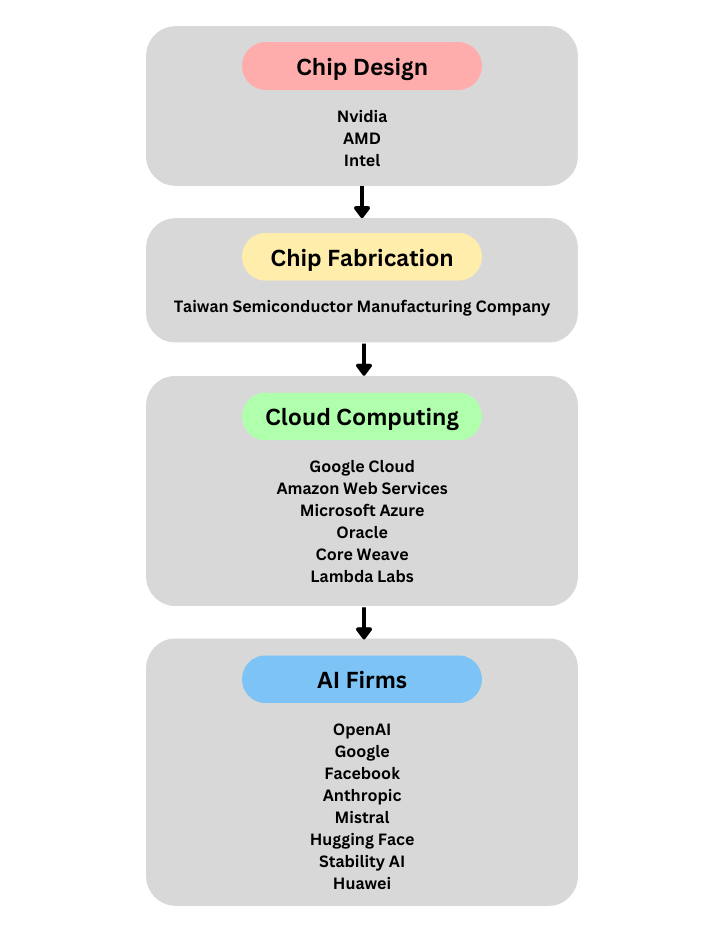
The next steps in the supply chain are even more constrained. Chip designers like Nvidia contract out the manufacturing, or “fabrication,” of their chips.[36] There are only a few firms in the fabrication market, and only one, Taiwan Semiconductor Manufacturing Company, is capable of manufacturing the H100 chips used in cutting-edge models.[37] Moreover, because of high fixed costs, the fabrication market is extremely difficult to enter: setting up a “fab” takes several years and costs around $10 billion.[38] The market is further limited by another bottleneck: only one company, ASML Holding, is capable of producing the photolithography machines used in fabrication plants.[39]
The last stage of the compute supply chain upstream from AI models is cloud computing.[40] Cloud computing providers buy chips from designers like Nvidia and aggregate them in mammoth data centers.[41] They then sell computing power to their clients, or, increasingly, use it for their own AI efforts.[42] As with the rest of the supply chain, there are high barriers to entry in the cloud computing market, as new entrants must make substantial investments and compete with wealthy incumbents for a limited supply of advanced chips.[43] As of 2023, three players dominated the market for cloud computing: Amazon Web Services (32% of the market), Microsoft Azure (23%), and Google Cloud (10%),[44] though Microsoft had a disproportionate supply of the H100 chips so coveted for AI.[45]
The constrained nature of this supply chain pushes the market toward consolidation. For example, in 2023 OpenAI signed a partnership deal with Microsoft to secure access to compute.[46] Similarly, AI start-up DeepMind sold itself to Google to ensure that it could continue to afford the costs of compute.[47]
Refusing to Deal
The supply chain for compute, with its many bottlenecks, creates the ability and incentive for AI firms to deprive competitors of computing resources. This section explores one type of anticompetitive conduct dominant firms could employ: “refusing to deal.”[48] A refusal-to-deal strategy would entail an AI firm with control over the supply of compute refusing to supply compute to the firm’s AI competitors. In this scenario, once the monopolizing firm starves its competitors of compute and forces them to exit the market, that firm would be free to raise the prices it charges downstream consumers.[49]
In addition to refusing to deal, there is another type of input foreclosure strategy that could be relevant—one usually called “exclusive dealing.”[50] This strategy would involve an AI firm monopolizing the market not as a supplier of compute, but as a buyer. To achieve this, an AI firm would have to gain monopsony power[51] and demand that compute suppliers deal with it exclusively.[52] If the firm truly did account for enough of the buying market, then compute suppliers would have little choice but to accede to the buyer’s demands, thereby depriving the buyer’s competitors of compute. While this may eventually be a viable input foreclosure strategy, it isn’t currently a significant risk. Most AI firms either lack significant buying power or are vertically integrated big-tech firms with internal compute supplies, meaning their compute suppliers can’t be coerced into ceasing to deal with them.[53] Therefore, I leave exclusive dealing to Section II.B, where I discuss it as a possible customer foreclosure strategy.
Overview of the Law
The prohibition on anticompetitive refusals to deal is an exception to the general rule. In general, a firm has the right to “exercise [its] own independent discretion as to parties with whom [it] will deal,”[54] but it cannot exercise that discretion in a way that “unduly interfere[s] with . . . trade and commerce.”[55] Distinguishing between business decisions motivated by free market competition and those that unduly interfere with competition can be a difficult task.
The foundational refusal-to-deal case is Aspen Skiing Co. v. Aspen Highlands Skiing Corp.[56] The defendant in that case, Aspen Skiing Company (Ski Co.)—owner of three out of the four ski areas in Aspen—withdrew from a longstanding agreement with Highlands—owner of the fourth.[57] The agreement had provided for a joint “all-Aspen” ski pass.[58] For many years, the pass had allowed customers to ski all of Aspen’s ski areas, regardless of ownership.[59] Ski Co.’s withdrawal devastated Highlands’s business: because customers were accustomed to the flexibility of multi-mountain passes, they still bought Ski Co.’s pass (now including only the three ski areas Ski Co. controlled), and visited Highlands much less often.[60] To stop the bleeding, Highlands tried to buy Ski Co. passes and bundle them with its own pass, creating a makeshift all-Aspen pass.[61] In response, Ski Co. blocked Highlands from purchasing its lift tickets.[62] Highlands also created another makeshift bundle, substituting Ski Co. lift tickets with equal value vouchers redeemable by vendors for their full cash value, but Ski Co. refused to accept them.[63]
Highlands sued Ski Co. for Sherman Act violations and won.[64] The 10th Circuit upheld that judgment, framing the issue as one of input foreclosure.[65] Under this framing, participation in the all-Aspen pass was an “essential facility,” or essential input, which Ski Co. denied to Highlands.[66] The Supreme Court affirmed, noting that “[t]he jury may well have concluded that Ski Co. elected to forgo . . . short-run benefits because it was more interested in reducing competition in the Aspen market over the long run by harming its smaller competitor.”[67] In other words, Ski Co. sacrificed short-term profits—the additional profits from Highland’s vouchers or ticket purchases, as well as the additional sales from customers who would be attracted by a four-area ski pass rather than just a three-area pass—to put Highlands out of business and gain a monopoly over the Aspen skiing market.
Though Aspen Skiing has not been overturned, jurists and scholars have recognized it as “at or near the outer boundary of § 2 liability,”[68] and later cases have “refused to extend liability to various other refusal to deal scenarios.”[69] One such case is FTC v. Facebook.[70] In that case, the FTC alleged that Facebook, by refusing to allow potential competitors to connect their apps to Facebook’s social media platform, had engaged in an illegal refusal to deal.[71]
In analyzing the case, the Facebook court distilled Aspen Skiing and its progeny into a three-part test for refusal-to-deal claims:
(1) “‘[T]here must be a preexisting voluntary and presumably profitable course of dealing between the monopolist and rival’ with which the monopolist later refuses to deal.”[72]
(2) “[T]he refusal to deal [must] involve[ ] products that the defendant already sells in the existing market to other similarly situated customers.”[73]
(3) “[M]ost importantly, ‘the monopolist’s discontinuation of the preexisting course of dealing must suggest a willingness to forsake short-term profits to achieve an anti-competitive end,’ . . . rather than to advance a valid business purpose.”[74]
Going further, the Facebook court noted that subsequent cases and treatises have added a “demanding gloss” to the third element.[75] To be an illegal refusal to deal, the court said, a mere “desire to limit entry by new firms or impede the growth of existing ones” is insufficient.[76] The defendant must have a “predatory motivation” which is the “only conceivable rationale” for “otherwise inexplicable profit sacrifice.”[77] The existence of any alternative rationale, it seems, will let the defendant off the hook.
The Facebook court held that the FTC failed to plausibly allege an illegal refusal to deal.[78] Applying the first element, the court noted that Facebook’s policy “was plainly lawful to the extent it covered rivals with which it had no previous, voluntary course of dealing.”[79] And, though the FTC alleged other refusals to deal with rivals with whom Facebook did have a prior relationship, the court saw no need to address them, because those refusals took place years before the FTC brought suit.[80] Therefore, they could not be the basis for the injunction the FTC sought, even if they had violated Section 2 at the time.[81]
Refusals To Deal in the AI Supply Chain
Refusals to deal in the AI market could play out a few different ways. For example, a monopolist in the AI market could integrate upward into compute markets, gain market power there, and then refuse to sell that compute to its AI rivals. This could happen, for example, if OpenAI, already a major player in the AI market, gained dominance in the compute market.[82]
Even more likely, given the current state of play—with chip maker Nvidia, and cloud computing providers like Microsoft, Amazon, and Google, dominating their respective steps in the supply chain—is that a dominant compute supplier integrates downward into the AI market and then refuses to sell compute to any of its competitors in that market. Indeed, Nvidia is already integrating downward to some extent: it uses the “promise of its H100 chip” to rent servers from Microsoft, Google, and Oracle and then re-leases those servers to AI developers at a premium.[83] Nvidia has also created foundation models of its own,[84] and it is working towards even more capable models.[85] Microsoft, similarly, has been using its cloud computing service to integrate both up and down the supply chain.[86] It is working to develop a chip of its own, specifically designed for AI.[87] And, through its partnership with OpenAI, in which Microsoft owns a 49% stake,[88] as well as with other AI firms, Microsoft is integrating downward into the AI market.[89] If Microsoft were to gain dominance over the cloud computing market, it could provide preferential, or exclusive, cloud computing to OpenAI, depriving OpenAI’s rivals of a critical input.
Is modern refusal-to-deal doctrine equipped to deal with such situations? In easy cases, yes. For instance, if Microsoft gained dominance in the cloud computing market and then stopped supplying compute to all of its AI customers but OpenAI, despite having excess compute it could have profitably sold, an antitrust plaintiff would have an easy case. That scenario would fit snuggly within the three-element Facebook test: (1) Microsoft would be ceasing to supply compute to customers with which it had previously dealt, (2) it would be continuing to supply compute to one favored customer, OpenAI, and (3) it would be sacrificing short-term profits that could only be recouped by knocking its AI competitors out of the market. On the other end of the spectrum, if Microsoft cut off compute to competitors to reallocate that compute to its own AI division, and if that compute resulted in substantial improvements to its AI’s performance, that would also be an easy case. While Microsoft would be depriving its competitors of a critical input, it would be doing so to make itself more competitive, not out of any “predatory motivation.”[90]
Unfortunately, real cases are likely to be somewhere in the middle. For example, imagine that Microsoft stopped supplying compute to AI competitors and reallocated that compute to itself but, crucially, with minimal improvement to its model’s performance. Is Microsoft doing so out of a genuine desire to improve its competitiveness, if only marginally? Or is that “valid business purpose” merely a pretext for predatory intent?[91] According to the “demanding gloss” of Facebook and its bedfellows, the answer may not matter.[92] If Microsoft can credibly claim that improving its model was a “conceivable rationale” for refusing to deal, it can survive the third Facebook element.[93] Thus, if courts adhere to Facebook’s three-part test, refusal-to-deal suits against compute suppliers will be very difficult to win.
But even if courts back away from Facebook—if, for example, they are willing to find defendants liable when their valid rationales are “conceivable” but, all things considered, implausible—antitrust enforcers will still have a hard job. This is because, to parse the legitimate business decisions from the anticompetitive ones, enforcers will need to discern firms’ motives. They will need to discern why a firm would decide to allocate compute one way instead of another. For AI companies that openly publish their results, enforcers may find clues in the data. If a compute monopolist continues to pump compute into a model well after the model’s performance has plateaued, when the monopolist could have made significant profits by selling that compute to others, that could signal antitrust enforcers to take a closer look. To receive that signal, antitrust enforcers must have some expertise in machine learning, and AI firms must openly share the results of their work. Neither is a given.
Policy Proposals: Toward Compute Neutrality
In a perfect world, many different firms would compete to supply compute, leading to a commoditization of supply. In that world, the price would be the primary driver of supplier behavior: firms would supply compute to whoever could pay for it. The market would be neutral about who receives computing power.
Unfortunately, this is not the world as it is. The supply chain for compute comprises multiple bottlenecks, controlled by a small number of powerful firms.[94] In this world, there is a risk of these firms not acting neutrally. Rather, they might use their control of compute to pick the winners and losers of the AI market. To do so, they would sacrifice short-term profits in the hope of monopolizing the AI market, after which they could recoup their costs many times over. In this world, there’s a risk that the models that survive do so not because they are the best, but rather because they have the best access to upstream resources.
To combat this, legislators should pass new laws empowering regulators to enforce compute neutrality. The goal of these policies would be to force compute suppliers to act in the tactical interest of their compute divisions (meaning maximizing the profit they receive from supplying compute) and not in the strategic interest of their foundation model partners. Achieving this goal will help ensure that AI models compete based on their abilities, not based on their firm’s ability to hoover up inputs.
Amending the Sherman Act for the AI age
Legislators should amend the Sherman Act to make it easier to allege illegal refusals to deal in the compute market. This should include changing the Facebook refusal-to-deal test, statutorily, in the following ways. For one, liability should apply for refusing to enter new deals, not just for exiting “preexisting” ones.[95] The first Facebook element, which precludes liability when there is no preexisting relationship, is grounded in two ideas.[96] First, by only scrutinizing preexisting relationships, the courts “advance[] the larger principle that unadulterated unilateral conduct—situations in which no course of dealing ever existed—won’t trigger antitrust scrutiny.”[97] Second, the element aids administrability, because “presumably profitable terms already agreed to by the parties may suggest terms a court can use to fashion a remedial order without having to cook them up on its own.”[98]
Though the impulse for restraint and administrability is noble, it should not dissuade lawmakers from pushing antitrust law in a more pro-competitive direction. Failing to penalize firms for refusing to deal when the firms have no preexisting relationship may prevent overreach, but it also prevents needed antitrust enforcement, especially in new markets where, because of their novelty, preexisting relationships will be rare. Plus, even without the preexisting-relationship requirement, the plaintiff would still need to prove that the defendant had a “predatory purpose”; it is unlikely an innocent business person, unaware that they are harming competition, could be found liable.[99] Moreover, there is a bipartisan desire to reign in market consolidation.[100] Realizing that desire will necessarily require empowering judges to exercise their discretion in more situations.
In addition, liability should not require that “predatory motivation” be the “only conceivable rationale” for a refusal to deal.[101] Such a rule makes it implausible that a compute supplier would ever be found liable, as it would be too easy for the defendant to plead a valid, but pretextual, alternative rationale for refusing to deal. A lower bar, such as clear and convincing evidence that predation was a motivation, should suffice.[102]
Mandatory Disclosure of Training Results
Even with the legislative changes outlined above, enforcing neutrality will not be easy. As discussed in Section I.B., determining a refusal-to-deal defendant’s motivations will be difficult, especially if the defendant can plausibly claim that reallocating compute to its own model will result in increased performance. Preventing price discrimination will also be difficult.[103] For example, in Microsoft’s deal with OpenAI, part of Microsoft’s compensation for supplying compute was the right to integrate OpenAI’s models into Microsoft’s products.[104] This form of compensation is hard to value, even for the parties themselves. In this type of deal, how can a regulator be sure that Microsoft is selling its compute for a neutral price instead of at a below-market price? Policing such conduct becomes harder still when it is entirely internal, within a vertically integrated compute/AI firm. In that case, compute isn’t “bought” in a conventional sense. To the extent it’s bought, it’s paid for in opportunity cost: the cost of keeping compute for one’s own AI division rather than selling it in the market. How should regulators weigh that opportunity cost against the potential benefits the firm gets from spending its compute on its own AI efforts?
To help antitrust enforcers and judges answer these questions, policymakers should mandate that AI firms disclose the results of model testing and the amount of compute used in model training.[105] This will help regulators discern whether firms are sacrificing short-term benefits in the hope of accruing monopoly gains. If a dominant compute supplier invests significant computing resources into its own models well after the point of diminishing marginal returns, while strictly limiting the supply of compute to competitors in the foundation model market, that doesn’t necessarily mean it is engaged in an illegal refusal to deal. However, it could be a hint that enforcement agencies should take a closer look, possibly by subpoenaing internal documents to see if the firm has anticompetitive motives. To get that hint, there must be disclosure.
This policy would not mandate that all models be fully open-source. AI firms would not need to disclose their actual algorithms, and the information that is disclosed could be hidden from the public—though there may be other reasons, beyond the scope of this article, to make it publicly available.
Limits on supplier deals
As noted above, complex deals that involve non-monetary compensation, such as trading compute for exclusive access to a firm’s foundation model, create difficulties for antitrust enforcers. One difficulty is that the compensation is hard to value, given the uncertain value of AI services. This makes it more difficult to discern when a compute supplier may be sacrificing short-term benefits—by supplying compute below-cost—to ensure its partner dominates the foundation model market.
To lessen the risks that these deals pose, policymakers should do two things. First, they should treat deals where compute suppliers take minority ownership of AI firms much like they would treat vertical mergers.[106] Such deals increase the incentive for a supplier to underprice compute for its partner or refuse to sell to the partner’s rivals because the supplier knows its sacrifice will be at least partially offset by the increase in profits for its partner.
Second, contracts between compute suppliers and AI firms that involve non-monetary compensation, such as supplying compute for the exclusive use of an AI model, should be statutorily limited in length. As the market for foundation models develops, exclusive access to these models will become easier to value. Therefore, forcing firms to renegotiate such deals often will give regulators more chances to analyze whether such compute-for-model swaps are valued fairly—or if a compute supplier is making a sweetheart deal in hopes of creating a downstream monopolist. It will also decrease the likelihood of an AI firm locking a compute supplier into a long-term contract, during which that compute provider could make a significant advance in compute technology that, due to the long-term contract, benefits only one AI firm.
Increased Scrutiny on Vertical Mergers
In recent decades, antitrust enforcers and judges have treated vertical mergers relatively leniently compared to horizontal mergers.[107] But that is changing, as evidenced by the DOJ and FTC’s 2023 Draft Merger Guidelines.[108] Some criticize these guidelines as too “aggressive,”[109] but, at least as applied to the AI supply chain, the Guidelines get it right. As the Guidelines note, “the risk of harm to competition [from vertical mergers] is greater when unintegrated rivals have fewer substitutes for the related product.”[110] This is certainly true of the AI market, where AI firms have few options for cloud computing, and where cloud computing firms have even fewer options for GPU semiconductors. In such a market, vertical mergers create the “ability and incentive” to exclude rivals from the market.[111]
The Guidelines’ “foreclosure share” thresholds are good, workable rules to guide courts in analyzing when to allow mergers along the AI supply chain.[112] According to the thresholds, if the foreclosure share—meaning the upstream firm’s control of a necessary input—is 50% or above, it would create a presumption that the merger is anticompetitive and should be blocked.[113] A merger between Nvidia and a downstream cloud computing firm would likely trigger this presumption, given Nvidia’s market share of advanced chips. For a foreclosure share below 50%, a range of factors would be considered, such as whether the market is trending toward integration, the nature and purpose of the merger, the general concentration of the market as a whole, and whether the merger increases barriers to entry.[114] Judges should heed these guidelines when examining mergers along the AI supply chain. If they are disinclined, Congress should pass a law requiring them to do so.
If All Else Fails: A Nationalized Compute Supply
If semiconductors are the “crude oil” of the information age,[115] maybe the U.S. should secure a strategic reserve. The most radical way of doing this would be to start a national semiconductor design & manufacturing corporation. Not only would this strengthen the U.S.’s hand geopolitically by decreasing its dependence on Taiwan and the Taiwan Semiconductor Manufacturing Company,[116] but it would also ensure a level of compute neutrality. This national corporation could sell its semiconductors strategically, ensuring that the cloud computing market remains competitive. It could also use its chips as leverage, cowing its buyers into supplying their services neutrally to downstream AI firms. If antitrust law fails to keep big-tech incumbents from leveraging their control of compute into control of AI, this more radical solution could help reestablish some competition.
Customer Foreclosure
Customer foreclosure is the anticompetitive strategy of harming competition by denying one’s competitors access to customers. For example, in Lorain Journal Co. v. United States, a newspaper holding a monopoly in Lorain, Ohio, used its monopoly power to prevent a rival, the radio station WEOL, from gaining customers.[117] It did so by refusing to accept advertising business from anyone who advertised or planned to advertise on WEOL.[118] The effect of this was to coerce local businesses into only advertising in the Journal, not on the radio station, thereby cutting off WEOL’s “bloodstream of existence.”[119]
There are a few ways to substantially foreclose access to customers in the AI market. One would be through “predatory pricing.”[120] This would entail a firm offering its model’s services to customers at a loss, burning through capital in the hope of grabbing market share and outlasting the competition.[121] Once its competitors have been eliminated, the firm would then be free to raise prices to supra-competitive levels, recouping its investment.[122] Although predatory pricing is a legitimate risk, it is not the focus of this article. Big tech firms have, arguably, engaged in such strategies in the past,[123] and AI firms are pricing their services below cost,[124] possibly to gain market share. But, given that many AI companies are either funded by deep-pocketed incumbents or are themselves deep-pocketed incumbents, it is unlikely that one firm will be able to bleed out its competitors, at least in the short or medium term; it is even less likely that the firm will then be able to raise its prices to supra-competitive levels without one of its competitors re-entering the market to undercut it.[125] The big players in the market have too much capital.
The remainder of this article will instead focus on two other types of anticompetitive conduct: “exclusive dealing” and “tying.” Applied to the AI market, these types of conduct would involve a firm controlling the platforms through which customers access AI and then closing those platforms off to the firm’s rivals. Because of the significant concentration within platform markets, there is a risk of AI firms trying to deprive their competition of a platform rather than competing fairly in the AI market itself.
The Market for AI Platforms
Currently, customers must pass through a series of access points, or “platforms,” to use AI services. For example, to use the browser version of OpenAI’s ChatGPT, one must (1) have a computer that (2) runs an operating system that (3) runs an internet browser which (4) can access OpenAI’s website. The ChatGPT “app” allows for the removal of step three, but the customer must still have a device that runs an operating system that is compatible with the ChatGPT app. Even if AI systems were to replace, or become fully integrated with, operating systems, they would still require some sort of device upon which to run. Thus, it is impossible for AI firms to entirely remove the intermediary between the AI and the customer. This gives platform firms power as gatekeepers of the AI market.
Figure 2: The distribution channel for AI services. If AI systems become fully integrated with—or gain the functionality of—operating systems, AI firms could bypass the second step in the chain.
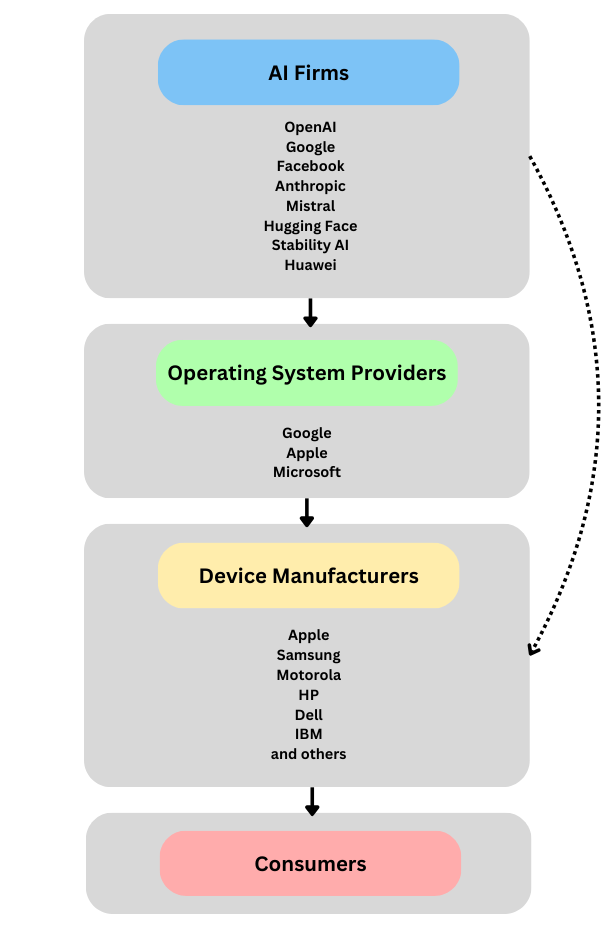
Platform markets are quite concentrated. In the market for mobile operating systems, Google’s Android system leads with a 77.6% market share, followed by Apple’s iOS, at 27.7%.[126] In the desktop operating system market, Microsoft’s Windows leads with 69%, followed by Apple’s OS X, at 21%.[127] The market for devices themselves is more diffuse,[128] however, the risk of concentration still exists. If this is “the twilight of the screen age,” as some claim, then the designers of new devices, which are “better suited to the back-and-forth of seeing, talking and listening AIs,” may grab a substantial share of tomorrow’s platform market.[129] Meta, Facebook’s parent company, is making such a bet with its augmented-reality glasses.[130] Apple and OpenAI are doing the same with new devices of their own.[131]
Exclusive Dealing
An exclusive dealing strategy would involve an AI firm using its market power to form an exclusive deal with one or more platform firms, such as with the makers of different operating systems. Because the market for operating systems is so concentrated, an exclusive deal between an AI firm and an operating system provider could “foreclose,”[132] or cut off, substantial distribution opportunities from that AI firm’s competitors. For example, this could happen if Google entered into a deal with Apple to make Google’s AI model the default AI on Apple’s operating system.
It is true that, once AI firms develop AI programs that can work as operating systems, the risk of foreclosure will be somewhat alleviated. Those firms would be able to market their programs to device makers directly, cutting out the operating system middleman. Because the device market is less concentrated than the operating system market, AI firms would have more avenues to reach customers. For example, even if Google gained exclusive distribution on Apple devices, Google’s AI competitors could still compete for deals with Samsung, Motorola, Huawei, and other device makers. However, the market for the AI-centric devices of the future might be more concentrated than the current smartphone market. If AI does require a new type of device for its benefits to be fully realized, then the first platform firm to create such a device could snap up substantial market share. If that happens, AI firms may try to lock that platform firm into a long-term, exclusive deal, thereby ensuring their own access to customers and foreclosing the access of their rivals.
Overview of Exclusive Dealing Jurisprudence
As with refusals to deal, exclusive dealing liability is an exception to a general rule—the rule that firms, even monopolies, may enter into exclusive contracts.[133] As courts have admitted, “[w]hether any particular act of a monopolist is exclusionary, rather than merely a form of vigorous competition, can be difficult to discern.”[134] The key to distinguishing the legal from the illegal is to identify exclusive dealing which is likely to “foreclose competition in such a substantial share of the relevant market so as to adversely affect competition.”[135]
For example, in United States v. Microsoft Corp., Microsoft used exclusive dealing to maintain its monopoly over PC-compatible operating systems.[136] Microsoft maintained that dominance, in large part, because of network effects. Because Microsoft had the “largest installed base”—meaning the most computers running its “Windows” operating system—software producers were more likely to write programs for Windows, which in turn made the Windows system even more attractive to customers.[137]
“Middleware” producers threatened to undermine Microsoft’s dominant position. These were producers of software that could run on top of multiple operating systems but also act as a platform for software applications.[138] One such company was Netscape, which produced an internet browser that could also serve as a primitive middleware platform.[139] Microsoft feared that, if Netscape continued to develop its browser’s capabilities, and if that browser were installed on enough computers, software developers would begin writing software for the Netscape browser instead of Microsoft’s Windows operating system.[140] This would erode Microsoft’s biggest advantage: the fact that consumers had to buy Windows to access the largest array of software applications.[141] If programmers could build their applications on top of Netscape, a consumer wouldn’t have to buy Windows to use those applications; the consumer could simply install Netscape on whatever operating system they liked. Microsoft would then be “required . . . to compete for operating system purchasers on price and features rather than relying on its dominant position.”[142]
To prevent Netscape from gaining a toehold, Microsoft imposed a variety of exclusionary conditions on original equipment manufacturers (OEMs) who wished to install Microsoft’s operating system on their devices—conditions which, because Microsoft was practically the only supplier of such operating systems, the OEMs had to accept.[143] These conditions included, amongst other things, prohibiting OEMs from altering the default internet browser on Windows-installed computers from Microsoft’s own Internet Explorer, and taking various other steps to make it more difficult for OEMs or customers to install Netscape.[144] Thus, Microsoft used its market power to impose de facto exclusionary contracts on OEMs to deprive Netscape of the chance to grow a customer base. This, the D.C. Circuit ruled, was anticompetitive conduct, in violation of Section 2 of the Sherman Act.[145]
A more recent example of exclusive dealing comes from United States v. Google.[146] In that case, the Department of Justice alleged that Google had, among other things, entered a de facto exclusive deal with Apple.[147] According to that deal, Google paid Apple $18 billion per year to be the default search engine on Apple’s Safari internet browser, the default browser on iPhones and Apple computers.[148] According to the DOJ, because the default settings are “sticky,” users of Apple devices rarely use any search engine other than Google.[149] Thus, other search engines, such as Yahoo, Bing, and DuckDuckGo, were substantially foreclosed from reaching customers.[150] Partially owing to this exclusionary deal, the DOJ alleged, Google amassed and maintained a 90% share of the internet search market.[151]
In a 2024 decision, a district court held that Google’s agreements with Apple and other browser providers amounted to illegal exclusive dealing.[152] Search engines, the court recognized, depend on scale.[153] With each consumer search, a search engine gains data that it can use to optimize future searches; with enough searches, a new entrant can obtain the minimum standard of quality necessary to compete in the search market.[154] By paying to be the default search engine, Google deprived upstart search engines of the necessary scale.[155] Thus, those payments amounted to monopoly maintenance.[156]
As of this writing, the Google trial has not reached its remedy stage. However, it appears the court will, at minimum, enjoin Google from entering into this type of default contract going forward.[157]
Exclusive Dealing in the AI Market
It is easy to imagine exclusive dealing in the market for AI services. Just as in Google and Microsoft, a powerful AI firm could contract to be the default provider on various distribution platforms, thereby depriving rivals of access to customers. It is also easy to see why an AI firm would want to do so. If generative AI follows the “winner-take-all” pattern of many other technology markets, the payoff for reaching the “tipping point” would be immense.[158] Even if these (de facto) exclusive deals are short-term losers for the AI firm, the long-term benefits of becoming the “Google” of generative AI would be worth the sacrifice.
Whether such deals proliferate may depend on the final outcome of Google. If the trial court’s decision survives appeal, it will provide a template for challenging exclusive dealing in the AI market. However, survival is not a given. Perhaps most vulnerable are the court’s conclusions regarding causation. One critic has argued that the plaintiffs did not meet their burden of proving that Google’s competitors were foreclosed because of the alleged exclusionary conduct.[159] Google argued that its competitors were so inferior that they would not have gained market share even without any exclusive dealing—an argument that may yet find a sympathetic audience.[160] Also noteworthy is that, by ruling against Google, the trial court ranged beyond the traditional “consumer welfare” standard.[161] Google, after all, is unlike the archetypal monopoly in that it has not used its monopoly power to raise consumer prices. It is possible that the DC Court of Appeals, or even the Supreme Court, will take a more narrow view of consumer harm, putting the decision at risk.
Ultimately, the fate of the AI market may depend not only on the final outcome of Google but also on the severity of the punishment and the speed with which antitrust enforcers can bring (and win) future cases. If the punishment is lenient, AI firms may decide that exclusive dealing is worth the price. And, if future enforcement is slow, it may come too late to matter. Because access to consumers can help AI firms optimize their products, AI firms that enter into exclusive deals may gain significant quality advantages such that, by the time those firms finally lose in court, they have an insurmountable lead on their competitors. If that happens, judicial remedies may be inadequate to reform the basic market structure. Thus, to prevent the AI market from becoming as concentrated as the market for internet search, enforcement against exclusive dealing must be strict and expeditious.
Tying
“Tying” in the AI market would involve a monopolist in the platform market requiring customers who want to use the monopolist’s platform to also use its AI services. Because of the monopolist’s dominance in the “tying” market—for operating systems or devices—customers would be forced to accept the “tied” product that comes along with it—the monopolist’s AI model. And, because customers are unlikely to pay for multiple AI services, or because the monopolist may preclude customers from using any other AI service on the monopolist’s platform, customers are likely to accept the monopolist’s AI model to the exclusion of all others. If refusing to deal in the AI market involves a monopolist in an upstream market (compute) spreading its monopoly downward, tying involves a monopolist in the downstream market (platforms) spreading its monopoly upward.
Overview of Tying Jurisprudence
Tying is “an agreement by a [firm] to sell one product but only on the condition that the buyer also purchases a different (or tied) product, or at least agrees that he will not purchase that product from any other supplier.”[162] This becomes problematic when the firm has market power in the tying market and uses that as “leverage” to gain market power in the tied market.[163] This happens when the seller’s power in the tying market induces customers to purchase the tied product when they wouldn’t have otherwise done so.[164] There are four elements in a tying violation: “(1) the tying and tied goods are two separate products; (2) the defendant has market power in the tying product market; (3) the defendant affords consumers no choice but to purchase the tied product from it; and (4) the tying arrangement forecloses a substantial volume of commerce.”[165] Of special importance to the AI industry—and the software industry more generally[166]—is the first element: whether the two goods are separate products.
The question of whether tying and tied goods are separate products “is pervasive because just about any product can be described as a tie of its components.”[167] Conversely, “just about any two products can be described as mere parts in a more encompassing whole.”[168] The most common test for determining when two products are, in fact, separate is the “competitive market practices test.”[169] As explained in Jefferson Parish Hospital District No. 2 v. Hyde, “no tying arrangement can exist unless there is a sufficient demand for [the tied good] separate from [the tying good] to identify a distinct product market in which it is efficient to offer [the tied good] separately from [the tying good].”[170] If, in a competitive market, consumers tend to purchase the two goods together, that is direct evidence of a single product.[171] Likewise, if firms without market power tend to bundle two goods together—as with left and right shoes[172]—that is indirect evidence of a single product, based on the idea that supply follows demand.[173]
However, the effectiveness of this test diminishes when dealing with a bundle that incorporates a new product or combines two products in an unprecedented manner. In such cases, there isn’t another “competitive market” with which to compare.[174] For such situations, scholars created a new test that asks “whether the items operate better when bundled by the defendant than when linked by the end user or an intermediary.”[175] If the defendant is in a unique position to integrate the two products, creating value that could not be replicated by a consumer buying the products separately and trying to combine them, then the bundle should be treated as a single new product rather than two products tied together.[176] For example, in the Microsoft monopolization case’s first trip to the D.C. Court of Appeals,[177] the court held that Microsoft did not illegally tie its Internet Explorer browser with its Windows operating system because they were a single new product.[178] “If Microsoft presented [customers] with an operating system and a stand-alone browser application, rather than with the interpenetrating design of Windows 95 and [Internet Explorer] 4,” the court wrote, “the [customers] could not combine them in the way in which Microsoft has integrated [Internet Explorer] 4 into Windows 95.”[179] Therefore, the two products could be legally bundled as one.
Tying in the AI Market
It is helpful to analyze tying at different levels of AI advancement. Upon their initial release, software like ChatGPT was impressive but relatively narrow. At that level of sophistication, the technology itself added little difficulty to the tying analysis. If a platform firm like Microsoft tied an AI chatbot to its operating system and contrived to exclude any other chatbots from being installed, those actions could be analyzed under existing case law. Because that case law has judged tying harshly, antitrust enforcers would have a good chance of snuffing out such naked tying schemes from the AI market.[180]
The harder problems arise as AI becomes more advanced. As the technology develops, it is likely to graduate from narrow applications into “agents.” As Bill Gates put it,
[currently,] [t]o do any task on a computer, you have to tell your device which app to use. You can use Microsoft Word and Google Docs to draft a business proposal, but they can’t help you send an email, share a selfie, analyze data, schedule a party, or buy movie tickets. And even the best sites have an incomplete understanding of your work, personal life, interests, and relationships and a limited ability to use this information to do things for you. That’s the kind of thing that is only possible today with another human being, like a close friend or personal assistant.
In the next five years, this will change completely. You won’t have to use different apps for different tasks. You’ll simply tell your device, in everyday language, what you want to do. And depending on how much information you choose to share with it, the software will be able to respond personally because it will have a rich understanding of your life. In the near future, anyone who’s online will be able to have a personal assistant powered by artificial intelligence that’s far beyond today’s technology.[181]
With agents, platform firms will have a ready defense to allegations of tying. They’ll say their platform and AI system compose a single, integrated product. Moreover, given the integration between operating systems and AI (indeed, integration may increase to the point where it no longer makes sense to speak of the two in separate terms) firms will have a good argument that they are the ones who must do the bundling. Most consumers would not be capable of it. Therefore, platform/AI firms could pass the “new product” test discussed above.
Difficult tying issues will also arise as AI models become localized. With current AI apps, most of the computing is done in “the cloud” and then transmitted to the consumer’s device.[182] However, as AI models become more efficient, developers will be able to make quality “local” models that operate partially—if not wholly—on the devices themselves.[183] Indeed, Microsoft is beginning to do so with its Copilot+ PC computers.[184] Making AI local will have benefits, like improved data privacy. Because local models would keep all of the user’s data on their device, such models can more safely tailor themselves to each user’s needs, tastes, and characteristics.[185] However, localization could also require integrating the model with the device’s hardware and other software to such an extent that it would be impractical for the device to host multiple local models. In addition, firms could argue that, even if the device could run other non-localized models, allowing the device to do so would defeat the purpose of the device’s localized model. The increased privacy that comes from localization, they could argue, would be destroyed if consumers could still access non-localized models. Thus, the localization of AI models would create novel, pro-competitive justifications for tying—justifications for which existing case law does not provide a clear roadmap.
These two innovations—integrated agents and localized models—will provide immense benefits, but those benefits could come at the cost of consolidation. One could imagine a world where the four biggest players in the platform markets—Microsoft, Google, Apple, and, possibly, Meta—also become the biggest players in the AI market simply because of their market share in the platform markets. This would happen if 1) all four made AI models which they then 2) bundled with their platforms and 3) excluded other AI models from those platforms. In other words, they would use their leverage in the platform market to gain market share in the AI market. This conduct could very well be legal, despite the fact it would substantially foreclose any AI company that didn’t have a platform of its own.
Policy Proposals: Toward a Neutral, Pluralistic Platform Market
The goal of policymakers should be to encourage AI firms to compete based on the merits of their AI models, not based on their control of the platform market. If they fail, the AI of the future may be the AI that had the best access to customers, not the one that was actually the best. To avoid such a fate, legislators and policymakers should enact the following reforms.
Platform Neutrality
Just as regulators should discourage monopolists in the compute market from picking winners in the market below, so too should they discourage monopolists in the platform markets from picking winners in the AI market above. To that end, deals where a platform provider grants preference to an AI firm on a basis other than quality should be prohibited. For example, deals like that between Google and Apple, wherein Apple made Google its default search engine because Google paid it to do so, would be barred. At least in the short term, this policy would ensure that smaller firms that do not have platforms of their own can still compete for customers.
The policy would not, however, ban platform firms from ever picking one AI service as their exclusive provider. As models become more integrated and localized, it may be reasonable to have only one AI system per platform. However, under this policy, an AI provider would be barred from paying for such exclusivity. It would need to compete with other AI firms, which the platform provider would then choose between based on their interest in maximizing their platform’s value.
In the short term, platform neutrality should also be applied to firms that produce both platforms and AI systems.[186] As long as AI software is relatively narrow, platform firms should not boost their own AI software over others or intentionally make their platform incompatible with competitors’ AI apps.[187] Only once AI becomes more fully integrated with the platform itself should platform firms be allowed to prefer their AI to others. At that point, when the platform and the AI cease to be separate products, it no longer makes sense to demand neutrality. Requiring firms to provide equal levels of integration to other firms’ AI software is unrealistic, and obligating platform companies to impartially select between their own AI and another’s, with the risk of facing legal consequences for failing to do so, could chill innovation. Hopefully, the advantages gained from the integration of AI models with platforms will compensate for the occasions when platform firms opt for their own, less effective AI instead of a superior model from a competitor.
Scrutinizing Platform Mergers
In a world of fully integrated AI, there might be only as many AI firms as there are platform firms. In fact, the platform firms might be the AI firms, with each having AI software that is tied to its platform. What’s more, existing tying jurisprudence might be incapable of stopping such a world, as the AI models and the platforms will cease to be “separate products.” Even if the Sherman Act could be amended to create liability in such situations, it’s not clear legislators should do so. Creating liability in such situations would chill innovation.
A better course would be to ensure diversity in the platform market so that more AI firms, including those without platforms of their own, can distribute their services to customers. In the near term, mergers between platform companies—both in the operating system and device markets—should be strictly scrutinized. Regulators and judges must recognize that further consolidation among platform firms could harm not just the platform market, but the AI market as well. Accordingly, when analyzing a merger between platform firms, regulators should weigh not just market concentration in the platform market, under normal horizontal merger criteria,[188] but should also weigh the possibility that the merger will foreclose distribution opportunities for AI firms in the market above.[189] The possibility of such foreclosure should count as a risk factor militating against the merger.
If All Else Fails: A Monopoly Tax
If scrutiny under existing laws fails and one or more platform firms monopolize the AI market, more drastic steps should be considered. One would be a monopoly tax: any firm above a certain market share would have to pay an additional tax, rising progressively according to market share. This would raise the monopolists’ costs, possibly forcing them to raise their prices and thus giving new entrants a better chance to grab market share. If the tax isn’t enough on its own, the revenues from the tax could be doled out to AI-platform startups as low-interest financing, in the hope of seeding a more pluralistic AI economy. While a monopoly tax may benefit any concentrated market, it could be especially important in a concentrated AI market. Traditional monopolies are bad, but they go only expand to the limits of their own market. An AI monopoly would be different. Because of AI’s versatility, an AI monopoly could span many different markets. To prevent such an economy-spanning monopoly, radical reforms, like a monopoly tax, may be needed.
Conclusion
AI has the potential to revolutionize the economy. With that revolution, however, comes risks, including the risks of incumbent firms using their power over upstream or downstream assets to monopolize the AI market. The job of legislators and antitrust enforcers is to prevent that from happening.
The proposals herein may provide some inspiration. If some of them seem radical, it’s important to remember the stakes. The AI revolution could cause a massive transfer of wealth from labor to capital as human labor is automated.[190] This problem will be even more acute if that capital accrues to a pitifully small number of firms—the firms who happened to control the input and platform markets when the tipping point came. If there is to be a massive transfer of wealth from labor to capital, policymakers should at least ensure that capital is widely held, not consolidated in the hands of a few firms and their shareholders. Antitrust law, updated for the AI age, is one tool that can help.
- J.D., North Carolina School of Law, 2024. The author thanks Professors Andrew Chin and Catherine Montezuma for their editorial guidance. ↑
- This article focuses specifically on “foundation models,” not the narrower applications that can be built on top of foundation models. Adopting from President Biden’s October 2023 executive order, this paper defines “foundation model” as “an AI model that is trained on broad data; generally uses self-supervision; contains at least tens of billions of parameters; is applicable across a wide range of contexts; and that exhibits, or could be easily modified to exhibit, high levels of performance” at tasks such as language or image generation, data analysis, image identification, or software coding. See Exec. Order. No. 14,110, 88 Fed. Reg. 75191, § 3(k)(Oct. 30, 2023) (defining “dual-use foundation model” and limiting the definition to models that that “exhibits, or could be easily modified to exhibit, high levels of performance at tasks that pose a serious risk to security, national economic security, national public health or safety, or any combination of those matters . . . .”). ↑
- See Generative AI Could Raise Global GDP by 7%, Goldman Sachs (Apr. 5, 2023), https://www.goldmansachs.com/intelligence/pages/generative-ai-could-raise-global-gdp-by-7-percent.html; Lareina Yee et al., How Generative AI Could Add Trillions to the Global Economy, World Econ. F. (July 14, 2023), https://www.weforum.org/agenda/2023/07/generative-ai-could-add-trillions-to-global-economy. ↑
- Ryan Abbott, The Reasonable Robot 39 (2020) (noting how income inequality in the U.S. has increased to the point where the wealthiest 0.1% of people is now worth as much as the bottom 90%, and discussing how AI could make the problem worse). ↑
- Jai Vipra & Anton Korinek, Market Concentration Implications of Foundation Models: The Invisible Hand of ChatGPT 2–3 (Brookings Inst. Ctr. on Regul. and Mkts., Working Paper No. 9, 2023). ↑
- Could OpenAI be the Next Tech Giant?, Economist (Sept. 18, 2023), https://www.economist.com/business/2023/09/18/could-openai-be-the-next-tech-giant. ↑
- ChatGPT reportedly costs approximately $700,000 a day to operate. Aaron Mok, Chatgpt Could Cost Over $700,000 per Day to Operate. Microsoft is Reportedly Trying to Make it Cheaper, Bus. Insider (Apr. 20, 2023), https://www.businessinsider.com/how-much-chatgpt-costs-openai-to-run-estimate-report-2023-4. ↑
- See Phillip E. Areeda & Herbert Hovenkamp, Antitrust Law: An Analysis of Antitrust Principles and Their Application ¶ 408 (4th ed. 2020). ↑
- See Minimum Efficient Scale, Corp. Fin. Inst., https://corporatefinanceinstitute.com/resources/accounting/minimum-efficient-scale-mes/ (last visited Dec. 13, 2023). ↑
- See Tim Stobierski, What Are Network Effects?, Harv. Bus. Sch. Online (Nov. 12, 2020), https://online.hbs.edu/blog/post/what-are-network-effects (defining “network effect” as “any situation in which the value of a product, service, or platform depends on the number of buyers, sellers, or users who leverage it”). ↑
- See Google Search Personalization and its Impact on SEO in 2024, Williams Media, https://williamsmedia.co/google-search-personalization (last visited Oct. 28, 2024) (providing an overview of how Google uses user data to optimize its search product). ↑
- This type of network effect was a key part of the government’s case against Microsoft in the 1990s. The government claimed that Microsoft maintained its dominance not because it sold the best computer operating system but because its operating system supported the most software applications. See United States v. Microsoft Corp., 253 F.3d 34, 83–84 (D.C. Cir. 2001). ↑
- Andrew I. Gavel, William E. Kovacic, Jonathan B. Baker & Joshua D. Wright, Antitrust Law in Perspective: Cases, Concepts and Problems in Competition Policy 1159–60 (4th ed. 2022). ↑
- See id. ↑
- See id. ↑
- Economist, supra note 5; see also infra Section II.B (discussing exclusive dealing). ↑
- See infra Section I.A (discussing the supply chain for compute). ↑
- See infra Section I.A (discussing the supply chain for compute); Economist, supra note 5 (discussing the dearth of engineers equipped to train and operate cutting-edge foundation models). ↑
- See Vipra & Korinek, supra note 4, at 19. ↑
- Thibault Schrepel & Alex ‘Sandy’ Pentland, Competition Between AI Foundation Models: Dynamics and Policy Recommendations 11 (MIT Connection Sci., Working Paper No. 1, 2023). OpenAI, for example, has already reached the point where simply adding more computational power and more data will not create substantial improvements. Will Knight, OpenAI’s CEO Says the Age of Giant AI Models is Already Over, Wired (Apr. 17, 2023), https://www.wired.com/story/openai-ceo-sam-altman-the-age-of-giant-ai-models-is-already-over/. ↑
- “Moore’s Law” is an observation—and a prediction—by Intel founder Gordon Moore that semiconductors get smaller and cheaper at regular intervals. Susannah Glickman, Semi-Politics: Intel and the Future of US Chipmaking, Phenomenal World (June 24, 2023), https://www.phenomenalworld.org/analysis/semi-politics/. ↑
- See Schrepel & Pentland, supra note 19, at 11. ↑
- 15 U.S.C.A. § 2 (West). Collusive conduct—which could take the form of competing AI firms conspiring to fix prices—is left for another day. Issues related to market definition, of which there are many, are also beyond the scope. ↑
- See Areeda & Hovenkamp, supra note 7, at ¶ 651a. Monopoly power does not mean total control of a market. Rather, it means “the power to control prices or exclude competition.” United States v. Grinnell Corp., 384 U.S. 563, 571 (1966). This power may be inferred from a firms’ high market share. See id. ↑
- See Gavel et al., supra note 12. Input foreclosure is sometimes referred to as “raising rivals’ costs.” See Areeda & Hovenkamp, supra note 7, at ¶ 1008. ↑
- United States v. Aluminum Co. of America, 148 F.2d 416, 432–34 (2d Cir. 1945). The district court ultimately held that the evidence did not prove that Alcoa purchased these inputs for the purpose of foreclosing competition. ↑
- Verizon Commc’ns Inc. v. Law Offs. of Curtis V. Trinko, LLP., 540 U.S. 398, 407–11 (2004). ↑
- See Amanda Athayde, Input Foreclosure As Theory Of Harm in Vertical and Conglomerate Mergers, (Sept. 11, 2023), https://ssrn.com/abstract=4568221. ↑
- See, e.g., McWane, Inc. v. FTC, 783 F.3d 814, 837–40 (11th Cir. 2015) (discussing “substantial foreclosure”). ↑
- Jai Vipra & Sarah Myers West, Computational Power and AI, AI Now Inst. (Sept. 27, 2023), https://ainowinstitute.org/publication/policy/compute-and-ai. ↑
- Guido Appenzeller, Matt Bornstein, & Martin Casado, Navigating the High Cost of AI Compute, Andreesen Horowitz (Apr. 27, 2023), https://a16z.com/navigating-the-high-cost-of-ai-compute/. ↑
- Jared Kaplan et al., Scaling Laws for Neural Language Models, arXiv (Jan. 23, 2020), https://arxiv.org/abs/2001.08361; see also Dario Amodei & Danny Hernandez, AI and Compute, OpenAI (May 16, 2018), https://openai.com/research/ai-and-compute/, (“[T]he amount of compute that is used to train a single model . . . is the number most likely to correlate to how powerful our best models are.”). As noted above, increasing compute causes diminishing returns after a certain point. ↑
- Vipra & West, supra note 29. ↑
- Id. ↑
- Id. ↑
- See id. ↑
- Id. ↑
- See Haydn Belfield & Shin-Shin Hua, Compute and Antitrust, Verfassungsblog (Aug. 19, 2022), https://verfassungsblog.de/compute-and-antitrust/ (discussing TSMC’s unique ability to produce the most advanced chips). ↑
- Id. ↑
- Id. ↑
- Vipra & West, supra note 29. ↑
- Id. ↑
- Id. ↑
- See id. ↑
- Id. ↑
- See Lauren Giret, Report: Microsoft and Meta to Receive 3x as Many Nvidia GPUs as Google and Amazon by End of Year, Thurrott (Nov. 28, 2023), https://www.thurrott.com/cloud/293683/microsoft-and-meta-to-receive-3x-as-many-nvidia-gpus-as-google-and-amazon-by-end-of-year. ↑
- Vipra & West, supra note 29. ↑
- Id. ↑
- See Areeda & Hovenkamp, supra note 7, ¶ 1437a. ↑
- See Max von Thun, Monopoly Power is the Elephant in the Room in the AI Debate, Tech Pol’y Press (Oct. 23, 2023), https://www.techpolicy.press/monopoly-power-is-the-elephant-in-the-room-in-the-ai-debate/. ↑
- See Areeda & Hovenkamp, supra note 7, ¶ 1800a. ↑
- Whereas monopoly power is concentration in the seller market and usually results in unnaturally high prices, monopsony power is concentration in the buyer market and usually results in unnaturally low prices. See Josh Bivens, Lawrence Mishel & John Schmitt, It’s Not Just Monopoly and Monopsony, Econ. Pol’y Inst: Raising Am.’s Pay (Apr. 25, 2018), https://www.epi.org/publication/its-not-just-monopoly-and-monopsony-how-market-power-has-affected-american-wages/. ↑
- This is similar to the exclusionary conduct of the defendant in McWane, though in that case the exclusive dealer exercised its leverage as a seller, not a buyer. See McWane, Inc. v. FTC, 783 F.3d 814, 819–22 (11th Cir. 2015). ↑
- See Hayden Field & MacKenzie Sigalos, AI Craze Is Distorting VC Market, as Tech Giants like Microsoft and Amazon Pour in Billions of Dollars, CNBC: Tech (Sept. 6, 2024), https://www.cnbc.com/2024/09/06/ai-craze-getting-funded-by-tech-giants-distorting-traditional-vcs.html. ↑
- United States v. Colgate & Co., 250 U.S. 300, 307 (1919). ↑
- Id. ↑
- See Aspen Skiing Co. v. Aspen Highlands Skiing Corp., 472 U.S. 585 (1985). ↑
- Id. at 589–93. ↑
- Id. at 589. ↑
- Id. at 589–91. ↑
- See id. at 593–95. ↑
- Id. at 593. ↑
- Id. ↑
- Id. at 594. ↑
- Id. at 595. ↑
- Aspen Highlands Skiing Corp. v. Aspen Skiing Co., 738 F.2d 1509, 1521 (10th Cir. 1984). See also id. at 1519 (“[A] business or group of businesses which controls a scarce facility has an obligation to give competitors reasonable access to it.” (quoting Byars v. Bluff City News Co., 609 F.2d 843, 856 (6th Cir. 1979))). ↑
- See id. at 1521 (“We are not convinced by defendant’s arguments based on its restrictive analysis that this is not a case of a vertical integration bottleneck. The substance of an essential facilities case was made.”) ↑
- Aspen Skiing, 472 U.S. at 608. ↑
- Verizon, 540 U.S. at 399. ↑
- Novell, Inc. v. Microsoft Corp., 731 F.3d 1064, 1074 (10th Cir. 2013). ↑
- FTC v. Facebook, Inc., 560 F. Supp. 3d 1 (D.D.C. 2021). ↑
- Id. at 24. ↑
- Id. at 23–24 (quoting FTC v. Qualcomm Inc., 969 F.3d 974, 993 (9th Cir. 2020)) (citing Novell, 731 F.3d at 1074). ↑
- Id. at 24 (quoting Qualcomm, 969 F.3d at 994). ↑
- Id. (quoting Novell, 731 F.3d at 1075). ↑
- Id. ↑
- Id. (quotation omitted). ↑
- Id. (quoting Qualcomm, 969 F.3d at 993) (emphasis added). ↑
- Id. at 32. ↑
- Id. at 24. ↑
- Id. at 25–27 (“[W]hile it is possible that Facebook’s alleged scheme of revoking API access from competitor apps could form the basis of a plausible refusal-to-deal claim under Aspen Skiing, the Court need not address that question.”). ↑
- Id. ↑
- Indeed, OpenAI, or at least its CEO, has grand ambitions to expand into compute markets. See Hayden Field, Openai CEO Sam Altman Seeks as Much as $7 Trillion for New AI Chip Project: Report, CNBC (Feb. 9, 2024), https://www.cnbc.com/2024/02/09/openai-ceo-sam-altman-reportedly-seeking-trillions-of-dollars-for-ai-chip-project.html. ↑
- See Vipra & West, supra note 29. ↑
- Id. ↑
- See Eric Pounds, NVIDIA Fast-Tracks Custom Generative AI Model Development for Enterprises, Nvidia (Nov. 15, 2023), https://blogs.nvidia.com/blog/custom-generative-ai-model-development/. ↑
- Stephen Nellis, Microsoft Introduces Its Own Chips for AI, With Eye on Cost, Reuters (Nov. 15, 2023, 1:18 PM), https://www.reuters.com/technology/microsoft-introduces-its-own-chips-ai-with-eye-cost-2023-11-15/. ↑
- Id. ↑
- See Tom Warren, Microsoft Extends OpenAI Partnership in a ‘Multibillion Dollar Investment’, Verge (Jan. 23, 2024, 8:14 AM), https://www.theverge.com/2023/1/23/23567448/microsoft-openai-partnership-extension-ai (“Rumors of this deal suggested Microsoft may receive 75 percent of OpenAI’s profits until it secures its investment return and a 49 percent stake in the company.”). ↑
- Microsoft, apparently, limited its equity in OpenAI to 49% to avoid antitrust scrutiny. It may not have worked. See Kim Mackrael, Microsoft-OpenAI Partnership Draws Scrutiny From U.K. Regulator, Wall St. J., https://www.wsj.com/business/microsofts-partnership-with-openai-to-be-probed-by-u-k-regulator-61e2379d (Dec. 8, 2023, 8:47 PM) (discussing U.K. regulators’ inquiry into whether the partnership is a de facto merger that could prompt a formal investigation); Andrew Ross Sorkin, et al., The F.T.C. Takes on A.I. Deals, N.Y. Times (Jan. 26, 2024), https://www.nytimes.com/2024/01/26/business/dealbook/ftc-ai-deals-microsoft-openai.html; see also Krystal Hu & Harshita Mary Varghese, Microsoft Pays Inflection $650 Mln. in Licensing Deal While Poaching Top Talents, Source Says, Reuters (Mar. 21, 2024, 5:26 PM), https://www.reuters.com/technology/microsoft-agreed-pay-inflection-650-mln-while-hiring-its-staff-information-2024-03-21/ (discussing Microsoft’s payment to use a prominent AI startup’s models and hire most of the staff). ↑
- FTC v. Facebook, Inc., 560 F. Supp. 3d 1, 24 (D.D.C. 2021). ↑
- See id. ↑
- Id. ↑
- Id. ↑
- Vipra & West, supra note 29, at 24. ↑
- See Facebook, 560 F. Supp. at 24. ↑
- See Novell, Inc. v. Microsoft Corp., 731 F.3d 1064, 1074–75 (10th Cir. 2013). ↑
- Id. at 1074. ↑
- Id. at 1075. ↑
- See id. ↑
- See, e.g., Press Release, Amy Klobuchar, U.S. Senator, Klobuchar, Grassley, Colleagues Introduce Bipartisan Legislation to Boost Competition and Rein in Big Tech (June 15, 2023), https://www.klobuchar.senate.gov/public/index.cfm/2023/6/klobuchar-grassley-colleagues-introduce-bipartisan-legislation-to-boost-competition-and-rein-in-big-tech. ↑
- Facebook, 560 F. Supp. 3d at 24 (quoting Qualcomm, 969 F.3d at 993) (emphasis added). ↑
- This reform would be far from radical. After all, Sherman Act Section 2 generally does not require the plaintiff to prove the defendant had the specific intent to monopolize. See Defiance Hosp. v. Fauster-Cameron, Inc., 344 F. Supp. 2d 1097, 1114 (N.D. Ohio 2004) (citing Aspen Skiing Co. v. Aspen Highlands Skiing Corp., 472 U.S. 585, 602 (1985)). ↑
- Price discrimination is illegal under the Robinson-Patman Act. See F.T.C. v. Morton Salt Co., 334 U.S. 37, 43–44 (1948). However, it is rarely enforced. Erik Peinert & Katherine Van Dyck, The Needless Desertion of Robinson-Patman, ProMarket (Oct. 10, 2022), https://www.promarket.org/2022/10/10/the-needless-desertion-of-robinson-patman/. ↑
- See Jordan Novet, Microsoft’s $13 Billion Bet on OpenAI Carries Huge Potential Along With Plenty Of Uncertainty, CNBC (Apr. 8, 2023 at 9:00 AM), https://www.cnbc.com/2023/04/08/microsofts-complex-bet-on-openai-brings-potential-and-uncertainty.html. ↑
- Federal agencies may already have a legal basis, in President Biden’s October 30, 2023, executive order, for requiring the disclosure of this information. See Exec. Order. No. 14,110, 88 Fed. Reg. 75191, § 4.2(a)(i) (Oct. 30, 2023). The language is broad, requiring the disclosure of “any ongoing or planned activities related to training, developing, or producing dual-use foundation models . . . [and] the ownership and possession of the model weights of any dual-use foundation models . . . .” Id. § 4.2(a)(i)(A)–(B). ↑
- Indeed, the several competition authorities may already be doing so. See sources cited supra note 89. ↑
- See Areeda & Hovenkamp, supra note 7, ¶ 1000 (noting that many critics believe vertical mergers should be deemed “per se lawful”). ↑
- U.S. Dep’t of Justice and Fed. Trade Comm’n, Draft Merger Guidelines (2023). ↑
- See, e.g., Joseph M. Rancour, Maria Raptis, Justine M. Haimi, Michael J. Sheerin & Bradley J. Pierson, As US Antitrust Agencies Double Down on Merger Enforcement Approach, New Deal Strategies Emerge, Skadden (Dec. 13, 2023), https://www.skadden.com/insights/publications/2023/12/2024-insights/antitrust/as-us-antitrust-agencies-double-down. ↑
- Draft Merger Guidelines, supra note 108, at 17. ↑
- Id. at 14–17. ↑
- See id. at 17. ↑
- Id. at 17. ↑
- Id. at 17–18. ↑
- Susannah Glickman, Semi-Politics: Intel and the Future of US Chipmaking, Phenomenal World (June 24, 2023), https://www.phenomenalworld.org/analysis/semi-politics/. ↑
- Id. (“Most importantly, a nationally-owned fab would ease tensions with China around US access to cutting-edge chips, helping avert a global crisis in the making.”). ↑
- Lorain J. Co. v. United States, 342 U.S. 143, 148–49 (1951). ↑
- Id. ↑
- Id. at 149. ↑
- See Areeda & Hovenkamp, supra note 7, ¶ 724. ↑
- See id. ↑
- See id. ↑
- See, e.g., Lina M. Khan, Note, Amazon’s Antitrust Paradox, Yale L.J. 710 (2017) (arguing that Amazon engaged in predatory pricing). ↑
- See Karen Kwok, AI Firms Lead Quest for Intelligent Business Model, Reuters (Dec. 12, 2023), https://www.reuters.com/breakingviews/ai-firms-lead-quest-intelligent-business-model-2023-12-12/. ↑
- See Brooke Grp. Ltd. v. Brown & Williamson Tobacco Corp., 509 U.S. 209, 227–28 (1993) (noting the difficulty of “recoupment” in a predatory pricing scheme). ↑
- Mobile Operating System Market Share Worldwide, StatCounter Global Stats (Apr. 2022), https://gs.statcounter.com/os-market-share/mobile/worldwide/#monthly-202204-202204-bar. ↑
- Desktop Operating System Market Share Worldwide, StatCounter Global Stats (Nov. 2023), https://gs.statcounter.com/os-market-share/desktop/worldwide/#monthly-202211-202311. ↑
- Mobile Vendor Market Share Worldwide, StatCounter Global Stats (Nov. 2023), https://gs.statcounter.com/vendor-market-share/mobile. ↑
- See So Long iPhone. Generative AI Needs a New Device, Economist (Oct. 5, 2023), https://www.economist.com/business/2023/10/05/so-long-iphone-generative-ai-needs-a-new-device. ↑
- Id. ↑
- Id. (discussing Apple’s virtual-reality headset and an unannounced project from OpenAI and former Apple designer Jony Ive). ↑
- See generally McWane Inc. v. FTC, 783 F.3d 814 (11th Cir. 2015) (discussing “substantial foreclosure”). ↑
- See id. at 827, 832 (noting that “exclusive dealing arrangements are common and can be procompetitive” and that they are “not per se unlawful”). ↑
- United States v. Microsoft Corp., 253 F.3d 34, 58 (D.C. Cir. 2001). ↑
- ZF Meritor, LLC v. Eaton Corp., 696 F.3d 254, 271 (3d Cir. 2012). ↑
- United States v. Microsoft Corp., 56 F.3d 1448, 1451 (D.C. Cir. 1995). ↑
- Areeda & Hovenkamp, supra note 7, ¶ 1801k. ↑
- See Microsoft, 253 F.3d at 53. ↑
- See id. at 47. ↑
- See Areeda & Hovenkamp, supra note 7, ¶ 1801k. ↑
- See id. ↑
- Areeda & Hovenkamp, supra note 7, ¶ 1801. ↑
- See Microsoft, 253 F.3d at 60–62. ↑
- Id. ↑
- Id. at 64. ↑
- United States v. Google LLC, 687 F. Supp. 3d 48 (D.D.C. Aug. 3, 2023). ↑
- Id. at 71–72. ↑
- See David Pierce, Google Reportedly Pays $18 Billion a Year To Be Apple’s Default Search Engine, Verge (Oct. 26, 2023), https://www.theverge.com/2023/10/26/23933206/google-apple-search-deal-safari-18-billion. ↑
- See Google, 687 F. Supp. 3d at 71–72. ↑
- See id. at 72. ↑
- See id. at 53. ↑
- United States v. Google LLC, No. 20-CV-3010 (APM), 2024 WL 3647498, at *103 (D.D.C. Aug. 5, 2024). ↑
- Id. at *109 (“Scale is the essential raw material for building, improving, and sustaining a [general search engine]”). ↑
- Id. at *111–13. ↑
- Id. at *97 (holding that Google’s agreements “kept [consumer use of rival search engines] below the critical levels necessary to pose a threat to Google’s monopoly.”). ↑
- See id. ↑
- See Dara Kerr, Google is Defiant After Losing Antitrust Lawsuit and Being Called a ‘Monopolist’, NPR (Aug. 6, 2024), https://www.npr.org/2024/08/06/nx-s1-5064669/google-loses-antitrust-monopoly-justice-department-lawsuit. ↑
- See supra notes 10–11 and accompanying text. ↑
- See Geoffrey A. Manne, A Critical Analysis of the Google Search Antitrust Decision, Int’l Ctr. for L. & Econ. (Aug 14, 2024), https://laweconcenter.org/resources/a-critical-analysis-of-the-google-search-antitrust-decision/. ↑
- See id. ↑
- See Adam Lashinsky, Opinion, The Google Decision Is the Right Ruling — at the Wrong Time, Wash. Post (Aug. 6, 2024), https://www.washingtonpost.com/opinions/2024/08/06/google-antitrust-ruling-late/. ↑
- Northern Pac. Ry. v. United States, 356 U.S. 1, 5–6 (1958). ↑
- Jefferson Parish Hosp. Dist. No. 2 v. Hyde, 466 U.S. 2, 14 n.20 (1984). ↑
- Id. ↑
- United States v. Microsoft Corp., 253 F.3d 34, 85 (D.C. Cir. 2001). ↑
- See id. at 90 (noting the difficulty of analyzing tying cases in which the tied good is “technologically integrated” with the tying good). ↑
- See Areeda & Hovenkamp, supra note 7, at ¶ 1741. ↑
- See id. (giving, as examples, “copiers and paper as part of a complete copying service; movie A and movie B as part of a complete exhibition schedule; surgical services and anesthesia as part of a complete operation; and equipment and maintenance service as part of a functioning machine . . . .”). ↑
- See Areeda & Hovenkamp, supra note 7, at ¶ 1745. ↑
- Jefferson Parish Hosp. Dist. No. 2 v. Hyde, 466 U.S. 2, 21–22 (1984). ↑
- United States v. Microsoft Corp., 253 F.3d 34, 86 (D.C. Cir. 2001). ↑
- See Areeda & Hovenkamp, supra note 7, at ¶ 1744. ↑
- See Microsoft, 253 F.3d at 86; Jefferson Parish, 466 U.S. at 21–22. ↑
- See Areeda & Hovenkamp, supra note 7, at ¶ 1746. ↑
- See Areeda & Hovenkamp, supra note 7, at ¶ 1746c (emphasis added). ↑
- See id. ↑
- United States v. Microsoft Corp., 147 F.3d 935 (D.C. Cir. 1998). ↑
- Id. at 952. ↑
- Id. ↑
- See Areeda & Hovenkamp, supra note 7, at ¶ 1700 (noting the traditional application of “per se” illegality rule to tying). ↑
- Bill Gates, AI Is About To Completely Change How You Use Computers, GatesNotes (Nov. 9, 2023), https://www.gatesnotes.com/AI-agents. ↑
- See Akash Takyar, AI in Cloud Computing: A Comprehensive Exploration of Key Advancements, LeewayHertz, https://www.leewayhertz.com/ai-in-cloud-computing/ (last visited Dec. 13, 2023). ↑
- See Benj Edwards, Meta Unveils a New Large Language Model that Can Run on a Single GPU, ars Technica (Feb. 24, 2023), https://arstechnica.com/information-technology/2023/02/chatgpt-on-your-pc-meta-unveils-new-ai-model-that-can-run-on-a-single-gpu/ (discussing the potential of localized AI models based on the release of Meta’s LLaMA-13B which claims to outperform GPT-3 despite being “10x smaller”). ↑
- Karen Weise & Brian X. Chen, Can Artificial Intelligence Make the PC Cool Again?, N.Y. Times (May 20, 2024), https://www.nytimes.com/2024/05/20/technology/microsoft-copilot-ai-pc.html. ↑
- Getting Personal With On-Device AI, Qualcomm (Oct. 11, 2023), https://www.qualcomm.com/news/onq/2023/10/getting-personal-with-on-device-ai (“An advantage of on-device AI is that the local AI model can still provide personalized responses, but without sharing that data back to the cloud, therefore enhancing data privacy.”). ↑
- Such firms include Google, with its Gemini AI system and Android operating system, and Microsoft, with its Copilot AI system and Windows operating system. See David Pierce, Gemini 1.5 is Google’s Next-Gen AI Model—and it’s Already Almost Ready, Verge (Feb. 15, 2024, 10:00 AM), https://www.theverge.com/2024/2/15/24073457/google-gemini-1-5-ai-model-llm; Michael Muchmore, What Is Copilot? Microsoft’s AI Assistant Explained, PCMag, https://www.pcmag.com/explainers/what-is-microsoft-copilot (June 18, 2024). ↑
- For a discussion on mandating interoperability in platform markets, see generally Herbert Hovenkamp, Antitrust and Platform Monopoly, 130 Yale L.J. 1952 (2021). ↑
- See U.S. Dep’t of Justice and Fed. Trade Comm’n, Horizontal Merger Guidelines (1992). ↑
- Cf. supra notes 110–12 and accompanying text (explaining “foreclosure share” in the context of input foreclosure). ↑
- See James Manyika et al., A Future That Works: Automation, Employment, and Productivity, McKinsey Glob. Inst. (2017), https://www.mckinsey.com/featured-insights/digital-disruption/harnessing-automation-for-a-future-that-works/de-DE (estimating that “about 47% of total US occupations are at a high risk of automation perhaps over the next decade or two”); Abbott, supra note 3, at 39–40 (discussing how automation could result in more income inequality). ↑