
Jessica de Perio Wittman[*]
Kathleen (Katie) Brown[+]
Academic law librarians have been instrumental in shaping technology competence in ABA-accredited law schools. Law librarians, leveraging expertise in information management, research methodologies, and technological literacy, foster innovation in legal pedagogy. In formal credit-bearing classes and informal non-credit-bearing training, law librarians facilitate the integration of cutting-edge tools and empower their communities with digital skills. This Article emphasizes and highlights how law librarians promote hard and soft legal technology skills across the curriculum to assist law schools in developing a rigorous program of legal education per ABA Standard 301. The Authors draw upon case studies and data from their Legal Technology Longitudinal Study to shed light on the contributions of law librarians in developing technology competence at ABA-accredited law schools. Additionally, the Authors provide their definition for technology competence. They recommend legal educators adopt this definition to ensure law schools create a rigorous program of legal education. Lastly, the Authors advocate that when law schools recognize, support, and actively include law librarian contributions throughout the curricula, they promote the cultivation of newly licensed lawyers who are prepared for the technological demands of the modern-day practice of law.
Table of Contents
I. The Role of Law Librarians in Shaping Legal Technology Education
A. Law Librarians Currently Foster the Authors’ Definition of Technology Competency
B. Overview of Law Librarians’ Involvement in Legal Technology Education
II. Selected Initiatives and Innovations by Law Librarians Towards Technology Competence Development
A. Chicago-Kent College of Law – Debbie Ginsberg, Emily Barney
B. Georgia State College of Law – Michelle Hook Dewey, Kristina Niedringhaus, Patrick Parsons
C. University of North Texas (UNT) College of Law – Korin Munsterman, Jennifer Wondracek
D. University of Oklahoma (OU) – Kenton Brice, Sean Harrington
E. Vanderbilt University – Mark Williams
III. Empirical Data on Legal Technology
A. Technology Adoption: Specializations, Advanced Degrees, Centers, Clinics, Labs, & Institutes
C. Technology Training by Instructor Status and Trending Topics
D. 2023 Law School Data Mining Project
IV. How Law Librarian Contributions Align with ABA Standard 301 and Comment 8 of Model Rule 1.1
A. Law Librarians Empower Their Law School Communities with Digital Skills
A. Forging Partnerships with Industry Leaders: Enhancing Technology Integration in Legal Education
Introduction
In today’s legal landscape, technology competence has become an expectation for attorneys, reshaping traditional practice and legal education.[1] This shift has left attorneys, law firms, and law schools grappling with the interpretation and implementation of Rule 1.1 of the ABA Model Rules of Professional Conduct, each emphasizing different aspects of technology.[2] While the ABA, state courts, and bar associations provide guidance on implementation and compliance, the response to this duty has varied widely among legal practitioners and educators.[3] For example, various competency models, such as the Whole Lawyer Model, were created to provide parameters and guidance around what makes a technologically-competent lawyer in modern-day legal practice.[4]
At many law schools, academic law librarians took on the challenge of providing training for students to be technologically competent.[5] Academic law librarians stay current with developments in legal practice through their continuous engagement in legal research and expertise in evolving vendor tools.[6] With many specializing in information science and legal practice, academic law librarians bridge doctrinal theory and real-world application, holistically preparing students for the technological demands of modern legal work.[7]
ABA Standard 301 mandates law schools create a rigorous program of legal education.[8] In response to Rule 1.1 and Comment 8, law schools have revamped their curricula to foster an array of technological skills and proficiency.[9] Yet, the lack of specificity in defining technology competence in practice has caused legal education to lag in adapting to rapid changes in law and society.[10] The measured pace of technology adoption by academic institutions, coupled with the absence of a clear definition for technology competence, creates a significant challenge in preparing students for contemporary legal practice.[11]
In response to the lack of a clear definition of technology competence in the legal profession, the Authors advocate that legal education institutions adopt their holistic definition for technology competence. We define technology competence in legal practice as a comprehensive understanding of how to ethically and practically apply and integrate both hard and soft technology skills.[12] Using competencies highlighted in the Whole Lawyer Model,[13] proficiency of hard skills requires leveraging relevant technologies effectively in legal practice, including but not limited to, communication platforms, legal research tools, and data security measures.[14] In addition to hard skills, technology competence incorporates the cultivation of soft skills essential for effective communication and client relations.[15] The legal profession has embraced and acknowledged that emotional intelligence should also be used to navigate the nuances of digital communication and maintain human-centered interactions in an increasingly digital environment.[16] We also assert that the obligation to remain abreast of technological advancements begins in law school, and this duty requires continuous engagement and understanding of technology’s role throughout a lawyer’s career.[17]
Law librarians can play an important role in promoting the teaching of legal technology skills across the curriculum and facilitating the development of a rigorous program of legal education that aligns with the Authors’ definition of technology competence and ABA Standard 301.[18] The Authors draw upon concepts from the Whole Lawyer Model, as well as case studies and data from their Legal Technology Longitudinal Study, to shed light on the contributions of law librarians in developing technology competence at ABA-accredited law schools in recent years.[19] Finally, the Authors advocate that when law schools recognize, support, and actively include law librarian contributions throughout the curricula, they ensure the cultivation of newly-licensed lawyers who are prepared for the technological demands of the modern-day practice of law.[20]
The Role of Law Librarians in Shaping Legal Technology Education
Law librarians enhance instructional methods to achieve technological competence by educating students to recognize blind spots and guard against technological indifference.[21] They also teach students that effectively keeping pace with technology calls for practical skills rather than rote memorization which may be required in doctrinal classes.[22] Law librarians teach law students how to actively engage with the benefits, risks, and infrastructure of relevant technology used in legal practice.[23]
From a research perspective, law librarians possess the skills to comprehensively examine the technological competency standards set forth by their state bar associations and advise law schools on developing legal technology curricula aligned with the expectations of that jurisdiction.[24] Additionally, law librarians investigate, implement, and negotiate contracts for technologies and software employed by legal practitioners to ensure the tools being taught are relevant and pragmatic for the business of law.[25] They also facilitate interdepartmental collaboration across law school faculty, administration, and staff to holistically weave legal technology training throughout the academic program and support services.[26] The move to digital legal information and the disruption of traditional publishing models require law librarians to possess a comprehensive understanding of emerging legal technologies.[27] By leveraging the expertise of their law librarians, law schools can effectively apply and integrate both hard and soft technology skills into the law school curriculum. This approach will better equip students with the technological competence required to navigate the complexities of modern-day legal practice with proficiency and ethical awareness.
Law Librarians Currently Foster the Authors’ Definition of Technology Competency
Law schools should recognize the unique qualifications of law librarians in cultivating technology competence within the legal profession. Law librarians apply the authors’ definition of technology competence because they have a comprehensive understanding of both hard and soft technology skills in their daily work.[28] As such, they inherently serve as valuable educators for students as they learn about technology tools in modern-day legal practice.[29] In law schools, law librarians provide comprehensive instruction on using databases[30], email systems[31], legal research tools,[32] artificial intelligence,[33] and data security measures,[34] equipping students with the practical skills needed for success in modern legal practice.[35] Additionally, law librarians offer tailored training on topics such as metadata,[36] information organization, [37] and knowledge management.[38] They also offer training on the integration of technology into everyday workflows, while promoting efficiency, accuracy, and ethical conduct.[39]
Additionally, academic law librarians excel at imparting soft skills crucial for effective communication and client (or patron) relations in a digital environment.[40] They must apply emotional intelligence when navigating the nuances of digital communication and maintaining human-centered interactions in their daily work.[41] Law librarians consciously demonstrate mindfulness, accessibility, and confidentiality.[42] For example, they prioritize active listening and thoughtful engagement with patrons, ensuring that their information needs are met effectively.[43] Law librarians also strive to ensure that legal information and resources are readily available to all users, regardless of their background or abilities.[44] They may implement accessible design principles in library spaces[45] and online platforms,[46] provide alternative formats for materials,[47] and offer personalized assistance to accommodate diverse learning needs.[48]
Confidentiality is also vital in the work of law librarians, who handle sensitive information regularly.[49] They adhere to strict privacy protocols[50] and ethical guidelines[51] to safeguard the confidentiality of patron records[52] and confidential research inquiries[53], which may involve implementing secure information management systems,[54] maintaining discretion in interactions with users,[55] and upholding professional standards of confidentiality.[56] Through their commitment to confidentiality, law librarians instill trust and confidence in their work product while supporting the ethical practice of law.[57]
The law librarianship profession is also committed to continuous learning.[58] This thirst for knowledge ensures that law librarians consistently remain up-to-date with the latest technological advancements,[59] enabling them to provide tailored guidance and support to law students, faculty, and other legal professionals seeking to enhance their technology competency.[60] Through this holistic approach to library services and professional development, law librarians can play a vital role in shaping technological proficiency in legal education, ultimately contributing to the delivery of high-quality legal services in today’s tech-driven landscape.[61]
Overview of Law Librarians’ Involvement in Legal Technology Education
In this modern digital era, technological competence has become indispensable for legal professionals. Law librarians have taken the lead in legal technology training, leveraging their expertise in legal research databases, practice management software, and emerging legal technologies.[62] In some law schools, law librarians have assisted in developing technology curricula that promote a rigorous program of legal education.[63]
From introducing foundational research skills to exploring cutting-edge AI applications, law librarians play a pivotal role in holistically preparing students for the technological realities of modern legal practice.[64] Staying abreast of evolving legal technology has enabled law librarians to incorporate skills training opportunities throughout the law school experience.[65] The authors assert that librarian-led training opportunities help ensure that graduates enter the profession armed with a comprehensive understanding of how to ethically apply and integrate hard and soft technology skills into their daily work.
Informal Training
Law librarians can provide law students with informal (yet essential) training on how to leverage technology to meet future client demands for cost-effective solutions.[66] Law librarians enable students to navigate legal research trends by cultivating both technical proficiency and critical thinking skills.[67] They guide students on tools, databases, and information sources, while simultaneously developing essential soft skills such as analytical reasoning and effective communication.[68] This comprehensive approach ensures students are well-equipped for the legal profession, even in institutions without formal technology training programs.[69] Law librarians collaborate closely with faculty members, often serving as guest lecturers in substantive law courses to provide technology-related instruction tailored to specific practice areas or legal topics.[70] This informal training goes beyond mere exposure to legal research resources; law librarians also train students to critically evaluate the accuracy, weight, and authoritativeness of retrieved information.[71] Since the volume of available information is constantly growing, law librarians must continue to teach students how to discern authoritative and reliable sources from those of questionable quality.[72] This training enables law students to be confident when making informed decisions and providing sound legal advice to their future clients.[73]
The legal profession continues to grapple with the rapid pace of technological change and its impact on the ethical practice of law.[74] This is compounded by the common misconception that newly licensed lawyers are digital natives and inherently proficient in technology.[75] As a result, law students must receive rigorous training on the benefits and risks surrounding emerging legal technologies, particularly when using AI-driven tools.[76] The consequences of relying on inaccurate or misleading information without additional training can potentially jeopardize cases, compromise legal strategies, or lead to sanctions as a violation of ethical and professional standards.[77] Through workshops, research consultations, and integrated classroom instruction, law librarians equip students with critical thinking skills and emphasize that AI tools should be used judiciously.[78] By doing so, they highlight the importance of maintaining professional integrity, safeguarding client confidentiality, and upholding ethical standards in the face of technological disruption.[79]
Formal Training
Law librarians also provide formal training on technology to law students and faculty through a variety of instructional avenues.[80] All research courses taught by law librarians provide training on leveraging databases, online research platforms, AI-driven legal research tools, and other research technologies that are relevant to the modern-day practice of law.[81] Additionally, at many institutions, law librarians teach dedicated legal technology courses.[82] Law librarians design and conduct seminars, workshops, and other credit-bearing course offerings that introduce students to legal technologies, such as practice management software, courtroom technology, document automation, litigation support systems, document management, electronic discovery, technology-driven simulations used in legal practice, and the ethical considerations surrounding technology use in the legal field.[83] By leveraging their expertise in legal research, information management, and emerging technologies across formal training settings, the authors assert that law librarians contribute to their law school’s ability to provide a rigorous program of legal education.
Selected Initiatives and Innovations by Law Librarians Towards Technology Competence Development
Law librarians have spearheaded several innovative initiatives to further enhance technology competency among law students and faculty. These include developing specialized legal technology courses, creating hands-on workshops for practical software applications, implementing digital literacy programs, and integrating AI and machine learning concepts into legal research instruction. Some librarians have also established technology labs within law libraries, providing students with access to cutting-edge legal technology tools and fostering an environment of experimentation and learning. Furthermore, collaborations between law librarians, legal technology companies, and law firms have resulted in tailored training programs that bridge the gap between academic knowledge and industry demands. We highlight a selected number of law librarians and their initiatives below.
Chicago-Kent College of Law – Debbie Ginsberg, Emily Barney
Debbie Ginsberg and Emily Barney have made significant contributions to promoting and developing technology competency in legal education during their time at Chicago-Kent College of Law. [84] Together, they implemented various initiatives to equip students and graduates with essential technology skills for legal practice.[85] Their work included teaching Word skills to first-year law students, covering topics such as styles, headings, pagination, tables of contents, and tables of authorities.[86] They also provided access to Procertas, an online assessment program for Word, Excel, and Acrobat Pro.[87] Additionally, they conducted technology-infused training for clinic programs.[88] Subsequently, Barney provided workshops on social media marketing, branding, and website development for new graduates in the Solo & Small Practice Incubator program.[89] Ginsberg and Barney’s work extended beyond the law school, as they presented their initiatives at national conferences such as AALL, ABA Techshow, and CALIcon.[90] They also regularly published on technology integration in the law school curriculum and contributed to the broader conversation on teaching technology in legal education.[91]
Georgia State College of Law – Michelle Hook Dewey, Kristina Niedringhaus, Patrick Parsons
In 2022, the Georgia State College of Law Library began the transition to take over responsibility for the law school’s Legal Analytics & Innovation Initiative (LAII).[92] Kristina Niedringhaus led the library’s efforts to take over and revitalize the program, resulting in the creation of a new Legal Technology & Innovation Department within the law library.[93] Michelle Hook Dewey, Legal Technologies Librarian, and Patrick Parsons, Associate Director for Legal Technology & Innovation, Executive Director for the Legal Analytics & Innovation Initiative, have been instrumental in developing and implementing the LAII’s curriculum.[94] They have created legal technology courses and have partnered with law firms, such as BakerHostetler, to provide students with practical experience in emerging technologies.[95] Dewey, Niedringhaus, and Parsons have all been active in promoting technology competency beyond the classroom, featuring in podcasts and conferences, contributing to publications and social media, and sharing insights on applied legal experience, research, and technology programs.[96] Under the leadership of the law library, the LAII’s Certificate in Legal Analytics & Innovation continues to prepare students for the technological demands of the legal profession.[97] The program’s renewed success is evidenced by its recognition as a top 10 finalist in Bloomberg Law’s inaugural Law School Innovation Program in 2022.[98]
University of North Texas (UNT) College of Law – Korin Munsterman, Jennifer Wondracek
UNT Dallas College of Law developed a curriculum focused on experiential learning to produce “practice-ready attorneys.”[99] A key component of this approach is the mandatory Practice-Related Technology Competency Requirement for all J.D. students.[100] This one-credit requirement is typically fulfilled through the Law Practice Technology course, which introduces students to various technologies used in legal practice.[101] The course familiarizes students with various innovative software platforms designed to enhance access to justice, capture legal expertise, interface with clients, manage litigation and transactional processes, and increase the efficiency and quality of legal services.[102] Topics covered range from Microsoft Office applications to advanced technologies like 3D printing and virtual reality.[103] Students can alternatively satisfy the requirement by completing Procertas lessons, as well as lessons found on other technology platforms, such as CLIO and Lynda.[104] Jennifer Wondracek was instrumental in establishing the requisites for completing this requirement at UNT Dallas.[105] Subsequently, Korin Munsterman further enhanced the program by offering multiple sections of the Law Practice Technology course every semester and now offers a distance learning option for students.[106] Drawing from her experience in law firms at Harvard, Munsterman focused on providing hands-on experience with tools used in legal practice and collaborated with technology vendors to teach skills in areas such as billing, practice management, document automation, and e-discovery.[107]
University of Oklahoma (OU) – Kenton Brice, Sean Harrington
In 2014, Dean Joseph Harroz, Jr. asked Darin Fox, Associate Dean and Director of the Law Library, “to develop, coordinate and lead OU Law’s Digital Initiative.”[108] Fox “enthusiastically took on the project and began writing a proposal, developing curriculum and coordinating the various facets of the Digital Initiative.”[109] He was instrumental in developing the initial plans, curriculum, and coordination. Kenton Brice joined OU Law in 2015 and focused on making the library a leader in technology and innovation.[110] In 2023, Sean Harrington became the Director of Technology Innovation at OU Law and is responsible for instruction and oversight of the Digital Initiative.[111] The four pillars of the Digital Initiative are 1) providing a technology platform; 2) providing a law practice-oriented technology curriculum; 3) providing technology-forward facilities;[112] and 4) providing access to and exploration in emerging technologies.[113] The Digital Initiative provides every incoming law student with an iPad configured with practice-ready products to create an immersive, technology-enabled learning experience.[114] Extensive training is also provided to students on using technology for productivity, legal research, law practice management, and courtroom presentations.[115] The training spans the students’ three years through “lunch and learn” sessions led by experts.[116] Curricular goals also include process improvement, design thinking, project management, leadership, and operational frameworks drawn from corporate legal operations.[117] Emerging technologies such as virtual/augmented reality and AI are explored for potential legal applications.[118] This digital focus has earned OU Law recognition as an Apple Distinguished School.[119]
Vanderbilt University – Mark Williams
Recognizing the significance of the technological shift to artificial intelligence in the legal field, Vanderbilt Law School Dean Chris Guthrie and Associate Dean for Academic Affairs Lisa Bressman asked Mark Williams (associate director of collections and innovation at the Alyne Queener Massey Law Library) and Cat Moon (director of innovation design for Vanderbilt’s Program on Law & Innovation) to organize a two-day faculty bootcamp.[120] This event introduced faculty to large language models (LLMs) based on generative AI technology.[121] Building on the bootcamp’s success, Vanderbilt pursued several initiatives.[122] Professors Williams and Moon launched a 1-credit AI in Legal Practice course in the fall 2023 and spring 2024 semesters.[123] A similar bootcamp was organized for second- and third-year law students in fall 2023.[124] The administration approved purchasing GPT-4 accounts for faculty to assist in their research.[125] The dean also formed a working group of faculty and Vanderbilt law librarians to develop a long-term strategy for how Vanderbilt may best engage with AI technology in the future.[126] Additionally, Vanderbilt launched the Vanderbilt AI Legal Lab (VAILL) to explore how AI can transform legal services and access to justice.[127] Williams emphasized that VAILL sees law students as a “risk free” testing ground for innovations, while also equipping them with adaptable learning capabilities to keep pace with the rapid evolution of artificial intelligence in the legal field.[128]
These case studies illustrate that different institutions have successfully leveraged law librarians when incorporating technology into their curricula. These case studies also highlight that technology is incorporated into the curriculum in a myriad of ways.
Empirical Data on Legal Technology
Law schools possess significant autonomy in designing their course curricula.[129] This autonomy allows law schools to align educational offerings with institutional values and create a rigorous program of legal education.[130] This flexibility leads to varied approaches when incorporating technology into legal education across different institutions.[131] Recognizing this trend, the authors have historically collected data to analyze how law schools are integrating technology into their curricula.[132] Based on that data analysis, the authors recommended that law schools supplement their J.D. programs with technology specializations, centers, clinics, and advanced degrees and align with the Whole Lawyer model.[133]
Technology Adoption: Specializations, Advanced Degrees, Centers, Clinics, Labs, & Institutes
Over time, the authors observed fluctuations in law schools’ adoption of technology within their curricula.[134] In 2017, 2.33% of respondents indicated that their law schools offered J.D. specializations in technology or advanced degrees (Masters, LL.M., or S.J.D./J.S.D).[135] That same year, 19.05% of respondents indicated that they have a legal technology center, lab, clinic, or institute affiliated with their law school.[136] In 2020, 23.08% of respondents indicated that they have a legal technology center, lab, clinic, or institute affiliated with their law school.[137] 0% of respondents that year indicated that their law schools offered J.D. specializations in technology or advanced degrees (Masters, LL.M., or S.J.D./J.S.D).[138] In 2023, 8% of respondents indicated that their law schools offered J.D. specializations in technology or advanced degrees (Masters, LL.M., or S.J.D./J.S.D).[139] That same year, 18.46% of respondents indicated that they have a legal technology center, lab, clinic, or institute affiliated with their law school.[140]
| 2017 | 2020 | 2023 | |
| JD specializing in technology or advanced degree (Masters, LL.M. or S.J.D./J.S.D.) | 2.33% | 0% | 8% |
| Center, clinic, lab, or institute focusing on technology | 19.05% | 23.08% | 18.46% |
Figure 1: Technology specializations, centers, and clinics at law schools, 2017-2023.
Law schools continue to prioritize theoretical instruction over practical skill. This creates an ethical dilemma because the ABA mandates law schools provide a rigorous program of legal education and produce practice-ready graduates.[141] Theoretical knowledge and practical skill are necessary to demonstrate the competence required for contemporary legal practice.[142] We assert that law librarians have historically, and continue to, take a leadership role in technology instruction at ABA-accredited law schools across the country.[143] Our longitudinal study results demonstrate that librarian instruction remains a fundamental component in providing skills-based and practice-based technology training within law school curricula. The longitudinal study also reinforces how law librarians have an established role in technology instruction and highlights how they deliver critical technology training within legal education.[144] Notably, many skills inherent to law librarianship align closely with the Foundations of the Whole Lawyer Model. The Foundations offer guidance on developing and integrating technology theory and practical competencies for attorneys in contemporary legal practice.[145]
In 2023, the authors established that 32 out of the 76 Foundations of the Whole Lawyer Model implicitly address technology competency skills in legal practice.[146] To evaluate how well law schools teach these technology competencies, the authors continued their analysis to include data from their 2020 and 2023 Law School Data Mining Projects and evaluate how well current ABA-accredited law school courses align with the authors’ definition of technology competence.[147] To conduct this assessment, the authors employ definitions and protocols in the Legal Services Innovation Index[148] as well as the 32 Foundations of the Whole Lawyer Model that the authors have identified are technology-related.[149]
Technology Skills Training in For-Credit Technology Courses, Informal Training & Doctrinal Offerings
The 2020 Legal Technology Survey revealed a significant gap in technology training at law schools, potentially impacting newly licensed lawyers entering practice in 2022-2023.[150] The survey’s only positive finding indicated that formal and informal technology training covered Microsoft Word and Excel approximately 30-40% of the time. [151] However, doctrinal courses generally failed to integrate instruction on these essential tools into their curricula.[152]
Notably, the survey exposed an absence of instruction in email, calendaring, and collaboration tools, despite the importance of these skills in contemporary legal practice.[153] These skills are fundamental to meeting professional standards, such as providing timely status updates, responding promptly to inquiries, and maintaining effective communication.[154] The lack of training in these areas is particularly concerning given that state bar associations offer continuing legal education on platforms such as Microsoft Outlook, Teams, Slack, Zoom, and WebEx. [155]
When it comes to research, formal law school classes cover several foundational skills from the Whole Lawyer Model to some degree. While the 2020 Legal Technology Survey did not explicitly inquire about legal research instruction, the authors can infer that all legal technology courses taught by law librarians address the necessary domains, competencies, and skills for today’s legal information professionals to succeed when conducting database and other digital-based research.[156] Law librarians are vital for curriculum enhancement at ABA-accredited law schools, providing approximately 50% of technology-related instruction.[157] Their courses often cover topics such as data analytics, competitive intelligence, and knowledge management, which are identified in four Foundations of the Whole Lawyer Model.[158]
Technology Training by Instructor Status and Trending Topics
The 2023 Legal Technology Survey continues the authors’ longitudinal study, providing updated insights into law school technology training.[159] The survey reveals significant progress and some persistent gaps in technology instruction at ABA-accredited law schools, comparing different instructor statuses and trending technology topics in for-credit technology courses, informal instruction settings, and doctrinal courses at ABA-accredited law schools.[160]
The 2023 survey indicates that Microsoft Word and Excel instruction has improved, with Word being taught in 62% of for-credit courses and 28.3% of informal offerings. Excel is covered in 55% of for-credit courses and 18.87% of informal sessions. These data points are higher than the 30%-40% reported in 2020, suggesting continued emphasis on these essential tools in legal education.
In 2020, no survey respondents reported that doctrinal courses included “practice-ready” basics such as Microsoft Word and Microsoft Excel.[161] In contrast, the 2023 survey shows the integration of technology topics in traditional doctrinal courses. Word is covered in 14.5% of doctrinal courses, while Excel is included in 9%. This indicates a slight improvement in incorporating these tools into broader legal education.
The 2023 survey included new topic areas, specifically asking whether artificial intelligence, large language models, email instruction, or e-discovery are included in for-credit technology courses, informal technology instruction, and doctrinal courses. Respondents indicated that artificial intelligence is taught in 79% of for-credit technology courses, 55% of informal technology instruction, and 31% of doctrinal courses. Large language models are taught in 53% of for-credit courses, 28% of informal technology instruction, and 13% of doctrinal courses. Respondents also indicated that e-discovery is taught in 59% of for-credit technology courses, 21% of informal technology instruction, and 36% of doctrinal courses. Lastly, respondents indicated that email is taught in 50% of for-credit technology courses, 19% of informal technology instruction, and 11% of doctrinal courses.
| For-Credit Technology Courses | Informal Technology Instruction | Doctrinal Courses | |
| Artificial Intelligence | 79% | 55% | 31% |
| Large Language Models | 53% | 28% | 13% |
| E-Discovery | 59% | 21% | 36% |
| 50% | 19% | 11% |
Figure 2: New topics added in the 2023 Legal Technology Survey
The Authors assert that the high integration of artificial intelligence and large language models in for-credit, informal, and doctrinal courses further supports the idea that law schools teach topics trending in practitioner publications and CLE opportunities.[162] While instructional progress in trending technology topics is evident, the integration of these topics in traditional doctrinal courses still remains relatively low.
Additionally, there is a consistent gap between coverage in trending technology instruction across all topics. For example, comparing the 2020 and 2023 data reveals an increase in professor involvement in for-credit technology courses, rising from 26.19% to 39%. Adjunct faculty participation in these courses also saw a modest increase from 28.57% to 31%. In contrast, informal technology instruction shows a slight decrease in professor involvement, dropping from 37.5% to 36%, while adjunct faculty participation in informal instruction marginally increased from 25% to 27%. These trends suggest a shift towards more formal, credit-bearing technology education led by professors, while informal instruction remains relatively stable with a small increase in adjunct faculty involvement.
| 2020 For-Credit | 2023 For-Credit | 2020 Informal | 2023 Informal | |
| Professor | 26.19% | 39% | 37.50% | 36% |
| Adjunct Faculty | 28.57% | 31% | 25% | 27% |
In contrast, the survey results for 2020 and 2023 reveal notable changes in librarian participation in both for-credit technology courses and informal technology instruction. The most notable increase is among faculty librarians, who saw the most significant jumps in both informal (29 percentage points) and formal (20.43 percentage points) technology instruction. The 2023 Legal Technology Survey also reveals that the percentage of adjunct librarians increased from 7.5% in 2020 to 20% in 2023, and there was an increase in non-faculty librarians from 15% to 29.5%.
| 2020 | 2023 | |
| Librarian (adjunct) | 7.5% | 20% |
| Librarian (faculty) | 37% | 66% |
| Librarian (non-faculty) | 15% | 29.5% |
Figure 3: Percentage of law librarians, by instructional status, offering informal technology instruction in law schools
Similarly, in for-credit technology courses, the percentage of adjunct librarians increased slightly from 9.52% in 2020 to 10% in 2023, and the number of non-faculty librarians nearly doubled from 7.14% to 15%.
| 2020 | 2023 | |
| Librarian (adjunct) | 9.52% | 10% |
| Librarian (faculty) | 28.57% | 49% |
| Librarian (non-faculty) | 7.14% | 15% |
Figure 4: Percentage of law librarians, by instructional status, offering for-credit technology instruction in law schools
Overall, there is a clear upward trend in librarian instruction, especially among faculty librarians in both informal and for-credit technology course settings. Our data indicates that librarian involvement in technology instruction has grown more rapidly than that of professors and adjunct faculty, suggesting an expanding role for law librarians in technology training in legal education.
2023 Law School Data Mining Project
The 2023 Law School Data Mining Project analyzed 460 courses, which were coded using the definitions and protocols in the Legal Services Innovation Index.[163] The protocols are alternative fees; artificial intelligence; blockchain and cryptocurrency; client education; connectivity; contract management; cybersecurity; data analytics; data privacy and protection; document assembly; electronic discovery; expert systems; incubator; information management; innovation entity; knowledge management; marketplace; people; process improvement; project management; services provided; cloud and alternative data storage; electronic communication, wireless internet, and passwords; and virtual private networks.[164]
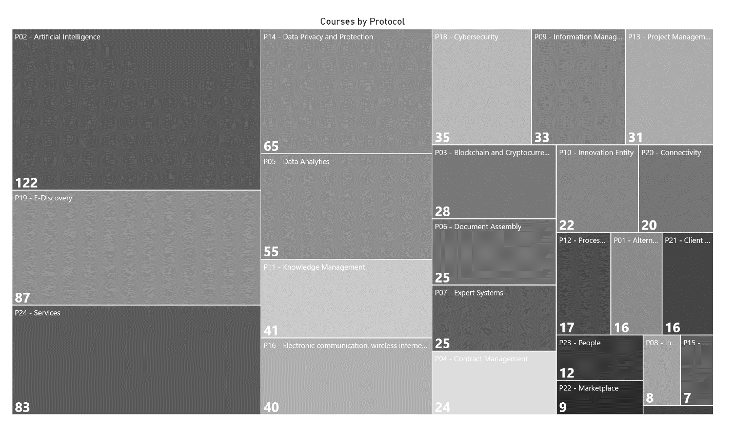
Figure 5: Cross-reference of courses from 2023 Law School Data Mining Project with the protocols in Legal Services Innovation Index.
The data analysis identified five emerging trends in law school course offerings: artificial intelligence, automation, cybersecurity, client demand for more legal solutions, and alternative legal services.[165] The authors also identified e-discovery as a trending topic in law schools.[166] These six trends align with frequently discussed topics in practitioner discourse, continuing legal education opportunities, and job descriptions.[167] The authors assert that law schools may be misled in their approach to curriculum development. By relying on practitioner resources, continuing legal education opportunities, and job descriptions to identify legal practice trends, these institutions mistakenly assume they are effectively aligning their course offerings with law firm expectations and hiring practices. However, this assumption may not accurately reflect the rapidly evolving technological demands of the legal profession.[168]
| 2020 | 2023[169] | |
| Artificial Intelligence | 97 | 122 |
| Automation | ||
| Contract Management | 16 | 24 |
| Document Assembly | 36 | 25 |
| Expert Systems | 11 | 25 |
| Cybersecurity | 195 | 35 |
| Data Privacy and Protection | 141 | 65 |
| Services | Data not collected | 83 |
| E-Discovery | 136 | 87 |
Figure 6: Course comparison for trending legal technologies from 2020 to 2023.
The data from the 2023 Law School Mining Project was also cross-referenced with the 32 Foundations that we identified from the Whole Lawyer Model that address technology and the applicable technology skills and tools that are relevant to the modern-day practice of law.[170]
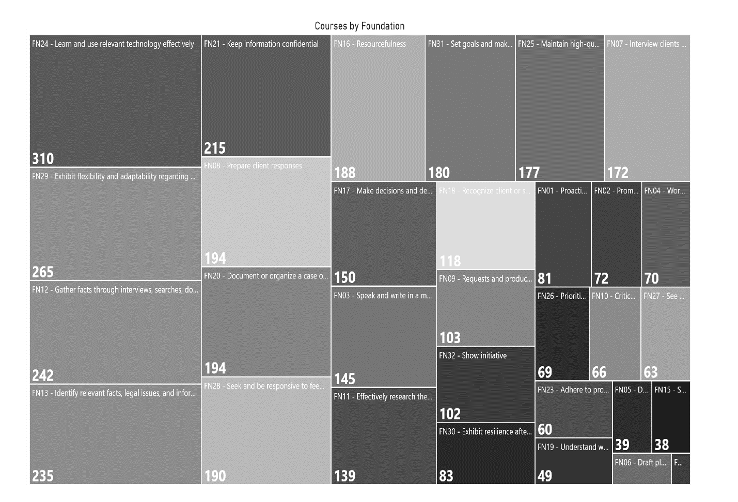
Figure 7: Cross-reference of courses with the 32 technology-related Foundations in the Whole Lawyer Model
When reviewing the cross-referenced course offerings from 2020 and 2023, five technology-related Foundations of the Whole Lawyer Model consistently trend in law school curricula: 1) exhibiting flexibility and adaptability regarding unforeseen, ambiguous, or changing circumstances; 2) gathering facts through interviews, searches, document/file review, and other methods; 3) identifying relevant facts, legal issues, and informational gaps or discrepancies; 4) keeping information confidential; and 5) preparing client responses.[171]
| 2020 | 2023[172] | |
| Exhibit flexibility and adaptability regarding unforeseen, ambiguous, or changing circumstances | 494 | 265 |
| Gather facts through interviews, searches, document/file review, and other methods | 286 | 242 |
| Identify relevant facts, legal issues, and informational gaps or discrepancies. | 295 | 235 |
| Keep information confidential | 468 | 215 |
| Prepare client responses | 217 | 194 |
Figure 8: Course comparison for technology-related foundations from 2020 to 2023.
Law librarians regularly perform 4 out of 5 of the technology-related Foundations,[173] making them ideally positioned to teach legal technology classes in law schools.[174] Law librarians leverage their practical technology expertise and interpersonal skills to teach law students how to ethically integrate both “hard skills” and “soft skills” in modern legal practice. By teaching these technology-focused classes and training sessions, law librarians bridge the gap between traditional legal education and the practical, tech-savvy skills identified in the Whole Lawyer Model, ensuring that new lawyers enter the field equipped to navigate the modern legal profession.
Overall, the survey highlights some gaps that may exist in ensuring graduating law students are developing key competencies for effective legal practice and leveraging technology appropriately.[175] To truly embody the “Whole Lawyer” skillset, today’s law students must take full advantage of the technology training offered by law librarians while in law school, who provide instruction on legal research databases, practice management tools, and emerging technologies like data analytics. Law students should also proactively seek out additional opportunities like extracurricular training offered by the law library, self-study, clinics, as well as internships, externships, and field placements to further develop technological competencies that are underemphasized, yet clearly essential, for effective legal practice.
While law schools have made strides in recognizing the importance of technology in legal education, there remains a significant opportunity to enhance and expand technology training to better prepare students for the demands of modern legal practice. The role of law librarians in bridging this gap is crucial, and their continued involvement in legal technology education will be instrumental in shaping the next generation of tech-savvy legal professionals.
How Law Librarian Contributions Align with ABA Standard 301 and Comment 8 of Model Rule 1.1
Academic law librarians have been instrumental in bridging the gap between doctrinal theory and real-world application of technology in legal practice.[176] Additionally, they play a critical role in supporting the educational mission of law schools and aligning with the standards set forth by the American Bar Association (ABA), including ABA Standard 301.[177] ABA Standard 301 requires law schools to maintain a rigorous program of legal education that prepares students for admission to the bar and for effective, ethical, and responsible participation as members of the legal profession.[178] In support of this standard, academic law librarians possess deep knowledge of legal research methodologies and tools, both traditional and technology-based, which they use to teach students crucial information literacy and legal research skills.[179] This includes training students on how to conduct comprehensive legal research using various databases and platforms, evaluate and select the most appropriate resources, and understand the benefits and risks of emerging technologies like AI-powered research platforms.[180] Through targeted instruction and guidance, law librarians equip students to meet the standards of professional competence required under ABA Standard 301.[181]
Law Librarians Empower Their Law School Communities with Digital Skills
Academic law librarians play a crucial role in empowering law school communities with the digital skills necessary for effective and ethical legal practice in the modern era.[182] Recognizing the growing importance of technology competence in the legal profession, law librarians are instrumental in integrating technology-driven research and a technology-focused curriculum throughout the law school experience.[183] For example, law librarians collaborate with faculty to ensure students are introduced to relevant tools and skills throughout their legal education, preparing them for the realities of technology-driven legal practice.[184]
Beyond curricular integration, law librarians provide various formal and informal training opportunities to develop students’ technological competence.[185] These include credit-bearing classes on legal research databases, e-discovery platforms, data analytics, and other essential legal technologies, as well as non-credit workshops, tutorials, and one-on-one consultations.[186] By continuously updating their knowledge base of legal technology trends and vendor tools, law librarians can offer students practice-oriented training that bridges the gap between doctrinal theory and real-world application.[187]
Law librarians also play a significant role in integrating ethical considerations related to technology use in legal practice by aligning their pedagogical efforts with the standards set forth in ABA Model Rule 1.1 and Comment 8. For example, through rules analysis[188] and scenario-based instruction,[189] law librarians train students on the responsible and appropriate application of legal technology, helping them develop an understanding of the benefits, limitations, and potential risks associated with various tools and platforms.[190] By emphasizing the ethical use of technology in legal education, law librarians provide instruction that allows future lawyers to fulfill their professional obligations to provide competent representation.[191]
Overall, law librarians take a holistic approach to developing instruction on technology competence, focusing on the hard and soft skills necessary for effective technology adoption and deployment.[192] They help students understand the benefits and risks of technology tools relevant to legal practice, develop a comfort level using different platforms, and improve their critical thinking and problem-solving abilities to meet future client needs.[193] Academic law librarians contribute to shaping competent and responsive legal professionals by equipping students with technology proficiency and essential soft skills.[194]
Law Schools Must Leverage Law Librarians’ Expertise to Teach Technological Competence Despite NextGen Bar Exam Limitations
Recognizing that technological competence is essential for effective and ethical lawyering in the 21st century, law librarians work diligently to bridge the gap between academic theory and real-world application.[195] They provide hands-on training with a diverse array of legal technology tools, from legal research databases and e-discovery platforms to data analytics and practice management software.[196] By equipping students with practical, experience-based knowledge, law librarians help ensure that newly licensed lawyers are prepared to navigate the technological aspects of legal work upon entering the profession.[197]
The NextGen Bar Exam, set to debut in July 2026, is being developed by the National Conference of Bar Examiners (NCBE) to provide a more comprehensive assessment of both foundational legal knowledge and practical lawyering skills.[198] This new exam aims to address concerns that the current Uniform Bar Exam (UBE) emphasizes rote memorization over competency in legal practice.[199] The NextGen format will include a variety of question types, such as stand-alone multiple-choice questions, integrated question sets that combine multiple-choice and short-answer responses, and performance tasks that simulate real-world legal scenarios.[200] It will cover core subjects including Civil Procedure, Contract Law, and Criminal Law, while also evaluating critical skills like legal research, client counseling, and negotiation.[201] By July 2028, all jurisdictions will be required to adopt the NextGen Bar Exam or choose an alternative licensure path, marking a significant shift in the approach to legal licensure assessments in the United States.[202]
It is worth noting that the NextGen Bar Exam is not including technology skills as part of their assessment. [203] By doing so, it falls short in fully recognizing the crucial role of technology in today’s legal profession.[204] While the exam plans to introduce computer-based testing, this alone is insufficient to assess candidates’ technological competence.[205] The exam’s practical, skills-based assessments could do more to emphasize the significant impact of basic technology on daily legal work.[206] By not adequately addressing technology’s role in legal practice, the NextGen Bar Exam misses an opportunity to align their assessment with the actual demands of contemporary legal practice.[207] As a result, the authors recommend that law schools must leverage their law librarians’ expertise to advance technology competency in legal education.
Call to Action: Integrating Law Librarians is a Key to Advancing Technology Competency in Legal Education
Integrating law librarians into the curriculum is also important for advancing technology competency within legal education. Their multifaceted experience with information literacy, legal research, technology, and instructional design enables them to prepare future lawyers to navigate the digital landscape of modern legal practice.[208] This integration allows law students to take classes designed to address the ethical obligations, soft skills, and practical demands expected in an increasingly tech-driven legal environment.[209]
When included, law librarians play a vital role in curriculum development and delivery.[210] They create engaging instructional programs that seamlessly blend hard and soft skills with technological proficiency.[211] Law librarians design comprehensive learning experiences and assess outcomes related to legal technology competencies.[212] When doing so, they ensure that technology training aligns with the rigorous standards set by ABA Standard 301.[213] This expertise also aligns with the technological competence expected of all attorneys under Comment 8 of Model Rule 1.1.[214] The inclusion of law librarians in curriculum development and delivery enhances the quality of legal education and its assessment and prepares students for the ethical realities of contemporary legal practice.[215]
Forging Partnerships with Industry Leaders: Enhancing Technology Integration in Legal Education
Law libraries play a vital role as sandboxes for AI products and services within the legal field.[216] Vendors recognize law students as future clients and strategically team up with law libraries to introduce their offerings.[217] Vendors, in conjunction with law librarians, offer hands-on training for a variety of tools regularly used in legal practice.[218] Law librarians often test, recommend, and deploy legal technology in their organizations, positioning them well to instruct students and faculty on the benefits and risks associated with relevant technology in the legal field.[219] They also leverage their vendor relationships to organize product trials and pilot programs, providing valuable hands-on learning experiences for students and faculty.[220] Law librarians also stay ahead of the curve by participating in beta testing, serving on vendor advisory boards, and attending legal technology startup pitch competitions.[221] They also host guest lectures and workshops featuring industry experts, exposing students to real-world applications and career opportunities in legal technology.[222] The authors assert that these collaborations between law librarians and vendors accelerate innovation and enhance the effectiveness of legal education to produce practice-ready graduates.
Law schools and firms also collaborate to enhance technological competency in legal education, fostering a culture of innovation.[223] Law librarians play a vital role in this partnership by organizing legal hackathons, establishing innovation labs, and providing students with exposure to practical technology applications.[224] Together, law schools and firms are developing joint internship programs which allow students to work with relevant technology tools in real-world settings.[225] Additionally, law librarian instructors regularly collaborate with firms to develop guest lectures, workshops, and case studies that showcase the latest technological advancements in legal practice.[226]
By cultivating strong relationships with industry leaders and technology vendors, law librarians help ensure graduates are equipped with essential technological competencies. The authors assert that this collaborative approach between academia, law librarians, and industry is crucial in preparing new lawyers for the evolving demands of the profession, bridging the gap between theoretical knowledge and practical application of legal technology.
Collaborating with Administrators and Faculty: Creating Effective Technology Competency Rubrics for Law School Courses
Law schools are increasingly recognizing the need to integrate technology competency into their curricula, and achieving this requires close collaboration between administrators, faculty, and law librarians.[227] By working together, the authors assert that stakeholders can develop comprehensive and forward-thinking strategies for technology integration that enhance the educational experience. Together, law librarians and faculty members can identify key technological competencies essential for modern legal practice and create a curriculum map that incorporates these skills across various courses.[228] This collaboration can also lead to the development of specialized legal technology courses that are tied more directly into doctrinal instruction.[229]
Law librarians can also assist faculty in crafting technology-enhanced assignments that align with course learning objectives and offer essential training and support for legal research platforms and practice management software.[230] To ensure effective implementation and assessment of these initiatives, it is crucial to develop clear technology competency rubrics for law school courses.[231] These rubrics should define specific, measurable technological skills that students are expected to acquire, outline different levels of proficiency for each skill, and provide clear criteria for evaluating student performance in technology-related assignments.[232]
The authors assert that, by creating collaborative rubrics, administrators, faculty, and law librarians can foster a shared understanding of expectations and learning outcomes, allowing for consistent assessment across courses. This approach not only provides students with a clear roadmap for developing their technological competencies but also serves as a foundation for ongoing curriculum evaluation and improvement. Ultimately, the authors posit that this collaborative effort ensures that law schools remain responsive to the evolving demands of legal practice, equipping students with the essential technology skills they need to succeed in their future careers.
Conclusion
The integration of technology competence into legal education is not merely an enhancement; it is a necessity for preparing future attorneys to meet the demands of a rapidly evolving legal landscape. Law librarians serve as facilitators of both hard and soft technology skills. By adopting the authors’ comprehensive definition of technology competence, law schools can align their curricula with ABA Standard 301, ensuring that graduates are not only knowledgeable but also adept in applying technology ethically and effectively.
The authors’ Legal Technology Longitudinal Study findings also highlight the necessity for law schools to recognize and support law librarians’ contributions to incorporate technology within their programs. The authors assert that it is crucial for institutions to foster an environment where collaboration thrives between faculty, administrators, and librarians. This collaborative approach will cultivate a generation of lawyers who have received comprehensive training in evolving legal research methods, fundamental technology skills, and cutting-edge tools for modern legal practice. By integrating the expertise of law librarians, law schools can ensure that their students are at the forefront of legal technology trends and develop competencies in light of the NextGen Bar exam.
Ultimately, embracing this holistic model of technology competence will empower law schools to produce graduates who are equipped to excel in an increasingly digital world, thereby fulfilling their ethical obligations under Model Rule 1.1. Moving forward, it is imperative that legal educators prioritize the integration of legal technology and library-led instruction in the curriculum. As the legal profession continues to evolve, law schools that embrace this comprehensive approach will not only meet current ABA standards but will also set a new benchmark for producing practice-ready graduates who are prepared to lead and innovate in the digital age of law.
- Director of the Law Library, Associate Professor of Law, and Cornelius J. Scanlon Scholar, University of Connecticut School of Law↑
- Associate Dean for Information Resources, Charleston School of Law. We also thank our student research assistants, Sarina Bhargava, Chloe Duger, Jessica Hernandez, Madison McElhinney, and Megan Phillips. © 2024, Jessica de Perio Wittman & Kathleen (Katie) Brown. We would also like to thank the participants of the Sixteenth Annual Conference on Legal Information: Scholarship and Teaching (a.k.a. Boulder-CoLIST), July 18-19, 2024, hosted by Northwestern Pritzker Legal Research Center for their helpful comments↑
- American Bar Association (ABA) Model Rule 1.1 of the Professional Rules of Conduct, together with Comment 8, imposes an ethical obligation on attorneys to maintain technological competence. Model Rules of Pro. Conduct r. 1.1 cmt. 8 (Am. Bar. Ass’n 2024) (“To maintain the requisite knowledge and skill, a lawyer should keep abreast of changes in the law and its practice, including the benefits and risks associated with relevant technology, engage in continuing study and education and comply with all continuing legal education requirements to which the lawyer is subject.”). ↑
- The drafting of Model Rule 1.1 is marked by ambiguity. Many states have adopted either the entirety or a modified version of Comment 8. To date, 40 states have adopted the duty of technology competence. Robert J. Ambrogi, Tech Competence, LawSites, https://www.lawnext.com/tech-competence [https://perma.cc/N7VA-UB7A] (last visited Feb. 17, 2025). For a more comprehensive history on ABA Model Rule 1.1 and Comment 8, see Jessica de Perio Wittman & Kathleen (Katie) Brown, Taking on the Ethical Obligation of Technology Competency in the Academy: An Empirical Analysis of Practice-Based Technology Training Today, 36 Geo. J.L. Ethics 1, 7–13 (2023). See also Jamie J. Baker, Beyond the Information Age: The Duty of Technology Competence in the Algorithmic Society, 69 S.C.L. Rev. 557, 570–77 (2018); Raymond H. Brescia, Teaching to the Tech: Law Schools and the Duty of Technology Competence, 62 Washburn L.J. 507, 511–15 (2023); Iantha Haight, Digital Natives, Techno-Transplants: Framing Minimum Technology Standards for Law School Graduates, 44 J. Legal Prof. 175, 195– 218 (2020). Most recently, the ongoing emergence of artificial intelligence (AI) has influenced legal practice, spanning areas such as legal research, predictive analytics, document management and automation, automation of routine tasks, and litigation analytics. See Litigation Support Trends Survey Summary, U.S. Legal Support (2024), https://www.uslegalsupport.com/wp-content/uploads/2023/12/U.S.-Legal-Support-2023-Litigation-Support-Trend-Survey-Summary.pdf [https://perma.cc/J7UZ-GVCQ]. Artificial intelligence is also expected to have an impact on the justice system and the courts themselves. See Thomson Reuters Inst., State of the Courts Report 2–5, 14–16, 32 (2024), https://legal.thomsonreuters.com/en/insights/reports/2024-state-of-the-courts-report/form?gatedContent=%252Fcontent%252Fewp-marketing-websites%252Flegal%252Fgl%252Fen%252Finsights%252Freports%252F2024-state-of-the-courts-report [https://perma.cc/88R3-77FJ]. In response, law schools have incorporated expanded training in artificial intelligence. See infra Part III. ↑
- For a comprehensive history of legal education in the United States and the role of the ABA, see generally James P. White, Legal Education in the Era of Change: Law School Autonomy, 1987 Duke L.J. 292. The Model Rules as set forward by the ABA are adopted individually by each state. Typically, the state bar association petitions the state supreme court with recommendations as to which rules to adopt or amend. The state supreme court then adopts the rule by releasing its opinion. de Perio Wittman & Brown, supra note 2, at 6 n.27. See also Lisa Z. Rosenof, The Fate of Comment 8: Analyzing a Lawyer’s Ethical Obligation of Technological Competence, 90 U. Cin. L. Rev. 1321, 1322–25 (2022). ↑
- Various competency models in legal practice have emerged, each reflecting a nuanced understanding of the skills and attributes essential for contemporary legal practitioners. From the traditional “I-shaped” lawyer (steeped in specialized legal knowledge) to the T-shaped lawyer (expanding the focus of legal practice beyond a deep legal expertise), to the Delta lawyer (balancing practice, process, and people while stressing the importance of technology competency) and the more holistic “Whole Lawyer” model (which encompasses technology proficiency alongside other foundational competencies), these models reflect the evolving expectations placed upon legal professionals. de Perio Wittman & Brown, supra note 2, at 15–18. The lawyering models underscore the concerted effort to bridge the gap between academic training and professional practice. Continuing Legal Education (CLE) programs, technology-focused certifications, and specialized training initiatives all contribute to the cultivation of technological competence among practicing attorneys. de Perio Wittman & Brown, supra note 2, at 13–14. ↑
- Associations, such as the American Association of Law Schools (AALS) and the American Association of Law Libraries (AALL), offered librarian-led panel discussions and created caucuses and subcommittees that focused on technological competency. In 2015, Darin K. Fox, Kenneth J. Hirsh, Jean P. O’Grady and Roger Skalbeck participated in innovative panel discussions at the AALS Section on Law Libraries and Legal Information Annual Meeting, emphasizing the critical need for technology competency and training in both the legal academy and law firms. See Darin K. Fox et al., Law Libraries and Legal Information 2015 Annual Meeting, Ass’n of Am. L. Schs. (Jan. 4, 2015), https://memberaccess.aals.org/eWeb//DynamicPage.aspx?webcode=SesDetails&ses_key=3c7b1460-ee96-4362-b0b8-252dfa77ca99 [https://perma.cc/E9EP-JDNP]. The following year, AALS chartered its Section on Technology, Law, and Legal Education. Section on Technology, Law & Legal Education, Ass’n of Am. L. Schs. (Aug. 17, 2016), https://www.aals.org/sections/list/technology-law-and-legal-education/ [https://perma.cc/8ZWY-CH45]. In 2017, AALL created a Teaching Legal Technology Caucus to bring law librarians together who were interested in teaching legal technology in law schools and other settings. See Camille Broussard et al., Teaching Legal Technology, 21 AALL Spectrum 22, 24 (2017); see also Jessie Wallace Burchfield, Tomorrow’s Law Libraries: Academic Law Librarians Forging the Way to the Future in the New World of Legal Education, 113 L. Libr. J. 5, 24 (2021) (discussing how law librarians created classes, competitions, and invitationals as curricular innovations). Another librarian-led workshop, Teaching the Teachers Conference, has also included sessions on teaching technology in legal education. Teaching the Teachers Conference, Penn State L. eLibr., https://elibrary.law.psu.edu/tttconference/about.html [https://perma.cc/T523-X5V4] (last visited Feb. 17, 2025) (“The Teaching the Teachers Conference provides a foundation in evidence-based instructional design, teaching techniques, and assessment for law librarians by law librarians.”). For workshop examples, see Will Monroe & Aimee Pittman, Shaping Future Lawyers: Integrating Gen AI in the Research and Writing Process to Teach Law Practice Technology (May 31, 2024); Michelle Hook Dewey & Heather Simmons, Modeling Everyday Technology: How to Integrate Practice-Ready Skills Into Your Course (May 12, 2022); Maria Truskey, Master Tour Virtual Presence: Communication Skills for the Teaching Librarian (Dec. 7, 2020); Kerry Lohmeier et al., Tech Talk: Technologies for the Virtual and Hybrid Environments (Dec. 7, 2020); Cas Laskowski et al., Engagement & Activities in Virtual & Hybrid Classrooms (Dec. 7, 2020). See also Julie Tedjeske Crane, Thoughts on Teaching Critical Information Literacy and Thinking Outside the Box, RIPS L. Libr. Blog (Dec. 6, 2023), https://ripslawlibrarian.wordpress.com/2023/12/06/guest-post-thoughts-on-teaching-critical-information-literacy-and-thinking-outside-the-box/ [https://perma.cc/KY7D-8BBG]. ↑
- For example, academic law librarians are usually involved in, and attend, workshops and trainings led by law librarians and vendors at the American Association of Law Libraries Annual Meeting and Conference. AALL Annual Meeting & Conference, Am. Ass’n L. Libr., https://www.aallnet.org/conference/ [https://perma.cc/CP34-NCQB] (last visited Feb. 17, 2025). ↑
- For further discussion on this topic, see Terry Hutchinson, Valé Bunny Watson? Law Librarians, Law Libraries, and Legal Research in the Post-Internet Era, 106 L. Libr. J. 579 (2014). Librarians have also presented on these topics. See Deborah Schander, Integrating the ACRL Framework for Information Literacy into Legal Research Classes (May 30, 2019); Patrick Parsons, Evaluation and Integration of Classroom Technologies (May 30, 2019). ↑
- Standards & Rules Proc. for Approval of L. Schs. 301 (2025) (“A law school shall maintain a rigorous program o1f legal education that prepares its students, upon graduation, for admission to the bar and for effective, ethical, and responsible participation as members of the legal profession.”). ↑
- This adjustment by law schools reflects an effort to align educational offerings with the evolving demands of law firms and hiring trends within the legal profession. Yet, law firms inconsistently communicate expectations for technological competence in job descriptions, often leaving prospective candidates with an unclear understanding of the technology skills required for success in legal practice. See generally Jessica de Perio Wittman & Kathleen (Katie) Brown, Navigating Legal Ethics and Law School Curricula: Attempting to Find Technology Competency Without a Compass, 20 U. St. Thomas L. J. 9 (2024). See also Thomson Reuters Inst., 2024 Report on the State of the US Legal Market 3 (2024), https://www.thomsonreuters.com/en-us/posts/wp-content/uploads/sites/20/2024/01/State-of-US-Legal-Market-2024.pdf [https://perma.cc/8BA2-ECY5] (explaining, for example, “[o]n the whole, law firm leaders appear to be optimistic about the potential that Gen AI offers for the future of the practice of law, but some skepticism remains.”); Carolyn Elefant & Jordan Turk, AI Trends Practical Uses and Policies for the Modern Law Firm (Feb. 22, 2024) (citing 74% of law firm respondents indicate that their hiring requirements have not changed, while 8% of law firm respondents are hiring for tech expertise and legal knowledge); Litigation Support Trends Survey Summary, supra note 2 (“With the investment in technology increasing in 2024, AI is becoming an important initiative for firms. 21% of firms utilized AI in 2023, and 25% of firms expect that to increase in 2024. 46% of respondents agree that AI tools will become mainstream in the legal profession within the next 3-5 years.”). ↑
- Various competency models in legal practice have emerged, each reflecting a nuanced understanding of the skills and attributes essential for contemporary legal practitioners. From the traditional “I-shaped” lawyer (steeped in specialized legal knowledge) to the T-shaped lawyer (expanding the focus of legal practice beyond a deep legal expertise), to the Delta lawyer (balancing practice, process, and people while stressing the importance of technology competency) and the more holistic “Whole Lawyer” model (which encompasses technology proficiency alongside other foundational competencies), these models reflect the evolving expectations placed upon legal professionals. Perio Wittman & Brown, supra note 2, at 15–18. The lawyering models underscore the concerted effort to bridge the gap between academic training and professional practice. Continuing Legal Education (CLE) programs, technology-focused certifications, and specialized training initiatives all contribute to the cultivation of technological competence among practicing attorneys. Id. at 13–14. ↑
- In Fall 2022, the University of St. Thomas Law Journal hosted a symposium titled “A Roadmap for Law School Modernity: Teaching Technology Competence,” which explored the various definitions of technology competency and how schools applied these definitions. The all-day symposium comprised of 12 law librarian speakers who are involved in law and technology at their respective institutions. Subsequently, in 2024, the St. Thomas Law Journal published their symposium issue. Michael Robak, An Introduction to A Roadmap for Law School Modernity: Teaching Technology Competence, 20 U. St. Thomas L.J. 1, 2 (2024) (“The question remains though, why, after a decade of recognizing the need for technology competence, law schools are still not effectively producing lawyers who are technology-competent?”). ↑
- We assert that this definition is suitably adaptable to meet the evolving nature of technological advancements in law and society. See Hon. John G. Browning, Advocacy in the 2lst Century: The Duty of Technological Competence and Today’s Trial Lawyer, 47 Nova L. Rev. 305, 312 (2023) (“The standard of technological competence is meant to be viewed broadly. . . . Consequently, technological competence should be viewed as a bar that continually rises. . . . [H]e should continually strive to stay informed and remain tuned in to the technological changes that are relevant to his practice.”). ↑
- In 2014, the Institute for the Advancement of the American Legal System (IAALS) launched Foundations for Practice, a multi-year national project aimed at identifying the foundational skills entry-level lawyers need, developing measurable models of legal education to support those skills, and aligning market needs with hiring practices. IAALS conducted a nationwide survey about necessary technology and practice competencies. Using this data, IAALS developed the Whole Lawyer Model, focusing on five learning outcomes and 76 Foundations that employers can use to evaluate candidates. Respondents identified that the “Whole Lawyer” requires foundational skills in areas such as technology/innovation, emotional/interpersonal intelligence, grit/resilience, and collaboration. Inst. Advancement Am. Legal Sys., Foundations: Educate and Hire the Best Lawyers 7 (2021), https://iaals.du.edu/sites/default/files/documents/publications/foundations_project_summary.pdf [https://perma.cc/Y3PH-V29Z]. See also Inst. Advancement Am. Legal Sys., Foundations: Hiring Guide 2–6 (2021), https://iaals.du.edu/sites/default/files/documents/publications/foundations_hiring_guide.pdf [https://perma.cc/KW6E-ZBP3]. ↑
- Inst. Advancement Am. Legal Sys., Foundations: Educate and Hire the Best Lawyers, supra note 13; see also de Perio Wittman & Brown, supra note 9, at 16–17. ↑
- See de Perio Wittman & Brown, supra note 9, at 42–43; Inst. Advancement Am. Legal Sys., Foundations: Educate and Hire the Best Lawyers, supra note 13; Inst. Advancement Am. Legal Sys., Foundations: Hiring Guide, supra note 13, at 33, 39. ↑
- de Perio Wittman & Brown, supra note 11, at 42–43; see also Ronald E. Wheeler, Soft Skills – The Importance of Cultivating Emotional Intelligence, 20 AALL Spectrum 28, 29 (2016) (citing Jack G. Montgomery of Western Kentucky University when explaining that “emotional intelligence is the ability to sense, understand, and effectively apply the power and acumen of emotions as a source of human energy, information, and influence”); see also How Emotional Intelligence Makes You a Better Lawyer, Am. Bar Ass’n (Oct. 2017), https://www.americanbar.org/news/abanews/publications/youraba/2017/october-2017/how-successful-lawyers-use-emotional-intelligence-to-their-advan/ (quoting Ronda Muir as stating “a leader sets the emotional tone for the group, impacting its productivity, level of conflict, ability to innovate and follow through on change, its mental and physical health and liability exposure.” Muir further observed that “emotionally intelligent lawyers communicate better, avoiding the No. 1 reason for disciplinary and malpractice claims in the U.S. and Canada . . . Further . . . there is evidence that unmanaged emotions like anger and frustration – and the habit of avoiding dealing with those emotions – are what put lawyers most at risk for not only a single disciplinary action but for multiple ones.”). ↑
- ABA Model Rule 1.1 and Comment 8 only apply to licensed attorneys in states that have elected to adopt these rules. Additionally, attorneys and scholars also started to explore the relationship between ethics rules and technology, suggesting that attorneys need to reconsider how they engage with technology while providing legal services. It became evident that “digital natives” entering the legal field, whether through law school or employment, lacked innate expertise in legal technology. Thus, they needed targeted skills instruction to attain technological competence. Haight, supra note 2, at 193 (“In contrast, many youth and young adults only know how to use technology for communication, entertainment, and perhaps basic word processing, and have no desire to learn what they need to succeed in the job market. After years of research, it appears that the reality is far more complex, ‘that there is as much variation within the digital native generation as between the generations.’”) (citing Sue Bennett et al., The ‘Digital Natives’ Debate: A Critical Review of the Evidence, 39 British J. Educ. Tech. 775, 779 (2008)). See also Burchfield, supra note 5, at 17 (“Staying abreast of technology trends and engaging in continuous training are absolutely essential for tomorrow’s law librarians as they support the teaching and scholarship of law faculty and help educate law students. Teaching law students how to competently use and manage law-related technology is imperative to their future success in practice.”). Historically, this targeted skills instruction in law schools has been provided by academic law librarians. Jessica de Perio Wittman & Kathleen (Katie) Brown, 2020 Law School Data Mining Project (on file with authors); Jessica de Perio Wittman & Kathleen (Katie) Brown, 2023 Law School Data Mining Project (on file with authors); de Perio Wittman & Brown, supra note 9, at 9, app. at 45–47. ↑
- Standards & Rules Proc. for Approval of L. Schs. 301(a) (AM. BAR ASS’N 2025) (“A law school shall maintain a rigorous program of legal education that prepares its students, upon graduation, for admission to the bar and for effective, ethical, and responsible participation as members of the legal profession.”). See supra note 12 for authors’ definition of technology competency. ↑
- Between 2017 and 2023, we released four surveys aimed at collecting information about legal technology course offerings at ABA-accredited law schools. In addition to these surveys, our research assistants curated data from the law school websites of all ABA-accredited law schools. The Legal Technology Longitudinal Study comprises of the surveys from 2017, 2020, 2021, and 2023 [hereinafter 2017 Legal Technology Survey, 2020 Legal Technology Survey, the 2021 E-Discovery Course Offering Survey, and 2023 Legal Technology Survey] as well as the data curated from the law school websites of all ABA-accredited law schools in 2020 and 2023 [hereinafter 2020 Law School Website Data Mining Project and 2023 Law School Website Data Mining Project, respectively]. ↑
- See generally Burchfield, supra note 5. ↑
- Law librarians, as informational omnivores, provide instruction in information management, research methodologies, and technological literacy in both formal credit-bearing classes and informal non-credit-bearing trainings. See Jessica de Perio Wittman & Kathleen (Katie) Brown, Legal Technology Longitudinal Study (on file with authors); see also Tad Simons, For a Lawyer, What Does “Technology Competence” Really Mean?, Thomson Reuters (Apr. 20, 2018), https://www.thomsonreuters.com/en-us/posts/legal/lawyers-technological-competence/ [https://perma.cc/PU2J-J5XS] (“To maintain a responsible awareness of the “benefits and risks” of relevant technologies, a lawyer today must be an informational omnivore with a sustained interest in technology as a fundamental building block of the contemporary world. And that interest must include a working knowledge of the infrastructure that enables and empowers today’s technology, if only to be made aware of one’s blind spots and protect oneself from the dangers of technological apathy.”). ↑
- Simons, supra note 21; see also Haight, supra note 2, at 188–92; see generally Burchfield, supra note 5. ↑
- Jessica de Perio Wittman & Kathleen (Katie) Brown, Legal Technology Longitudinal Study (on file with authors); see also infra Part II. ↑
- See infra Part II. ↑
- Law librarians are adept at negotiating large-scale legal research platforms on behalf of their institutions. For example, the American Association of Law Libraries Committee on Relations with Information Vendors has developed tools to help law libraries work with legal vendors. CRIV Tools, Am. Ass’n L. Libr., https://www.aallnet.org/advocacy/vendor-relations/criv-tools/ [https://perma.cc/A3Y4-TRLJ] (last visited Feb. 17, 2025). These tools include checklists, sample forms and letters, and publications such as the Guide to Fair Business Practices for Legal Publishers and Principles and Practices for Licensing Electronic Resources. See generally Am. Ass’n L. Libr., AALL Guide to Fair Business Practices for Legal Publishers (4th ed. 2018), https://www.aallnet.org/wp-content/uploads/2018/05/Guide-to-Fair-Business-Practices-Fourth-Edition-FINAL.pdf [https://perma.cc/8BV5-FXM3]; Am. Ass’n L. Libr., AALL Principles & Practices for Licensing Electronic Resources (2018), https://www.aallnet.org/wp-content/uploads/2018/05/Principles-and-Practices-for-Licensing_05.30.2018_FINALpdf [https://perma.cc/95ZC-E88A]. ↑
- Jessica de Perio Wittman & Kathleen (Katie) Brown, A Comparative Study on Process Optimization and the Modern Law Library’s Involvement in Achieving Efficiency at the Law School in Times of Change, 39 Legal Ref. Serv. Q. 1, 198–202 (2020); see also infra Part II. ↑
- For example, the University of St. Thomas Fall 2022 Law Review Symposium on “A Roadmap for Law School Modernity: Teaching Technology Competence” highlights several law librarians who are teaching and publishing in the legal technology space within legal education. University of St. Thomas Minnesota, A Roadmap for Law School Modernity: Teaching Technology Competence, YOUTUBE (Nov. 4, 2022), https://youtu.be/hILd5qJ1G4I?si=1kJhT4DZi6tikWn6 [https://perma.cc/PS9L-F2JK]. Additionally, the panels and speakers focused on explaining what needs to transpire to increase law school administration and faculty awareness regarding legal technology as a path for future opportunities and employment. Id. ↑
- See supra note 12 for authors’ definition of technology competence. ↑
- For a discussion on the pedagogical role of law librarians in academic institutions, see Dustin Johnston-Green et al., Pedagogy, in Introduction to Law Librarianship 189–200 (Zanada Joyner & Cas Laskowski eds., 2021). ↑
- Johnston-Green et al., supra note 29, at 199; AnnaLee Hickman et al., Reference Work, in Introduction to Law Librarianship 79 (Zanada Joyner & Cas Laskowski eds., 2021). ↑
- Johnston-Green et al., supra note 29, at 199. ↑
- Johnston-Green et al., supra note 29, at 193–96; Hickman et al., supra note 30, at 85–86. ↑
- See de Perio Wittman & Brown, supra note 2, at 29, 30 n.225, 31; Johnston-Green et al., supra note 29, at 197. ↑
- See de Perio Wittman & Brown, supra note 2, at 29, 30 n.225, 31; Johnston-Green et al., supra note 29, at 197. ↑
- See de Perio Wittman & Brown, supra note 2, at 29, 30 n.225, 31; Johnston-Green et al., supra note 29, at 199. ↑
- Library Systems and Resource Discovery SIS, Am. Ass’n Of L. Libr., https://www.aallnet.org/lsrdsis/ [https://perma.cc/PDD7-ZRAL] (last visited Feb. 17, 2025) (displaying areas of interest including metadata). ↑
- Body of Knowledge [BoK], Am. Ass’n L. Libr., https://www.aallnet.org/education-training/bok/ [https://perma.cc/P76D-XPCS] (last visited Feb. 17, 2025) (“Ensur[es] and facilitate[es] timely access to relevant legal information [to] foster sound legal arguments and wise legal decisions while mitigating loss and risk.”). ↑
- Id. (“Ensur[es] and facilitate[es] timely access to relevant legal information [to] foster sound legal arguments and wise legal decisions while mitigating loss and risk.”). ↑
- Jessica de Perio Wittman & Kathleen (Katie) Brown, Legal Technology Longitudinal Study (on file with authors). See generally de Perio Wittman & Brown, supra note 26. See also Syllabi Commons, Teaching Tech. L. Students Special Interest Group, https://techforlawstudents.classcaster.net/syllabi-commons/ [https://perma.cc/H9R7-GW92] (last visited Feb. 17, 2025). Academic law librarians also adhere to ethical principles set forth by the law librarianship profession. See AALL Ethical Principles, Am. Ass’n L. Libr., https://www.aallnet.org/advocacy/government-relations/recommended-guidelines/aall-ethical-principles/ [https://perma.cc/ZT87-588A] (last visited Feb. 17, 2025). ↑
- Robert C. Berring, Legal Information and the Search for Cognitive Authority, 88 Cal. L. Rev. 1673, 1676 (2000). ↑
- Gerard Fowke, Emotional Intelligence in the Law Library, RIPS L. Libr. Blog (Aug. 1, 2023), https://ripslawlibrarian.wordpress.com/2023/08/01/emotional-intelligence-in-the-law-library/ [https://perma.cc/SJ4B-AXD9] (“Building relationships is an essential part of being a successful law librarian, and social skills are the components of emotional intelligence that facilitate these relationships.”). ↑
- See generally Filippa Marullo Anzalone, Zen and the Art of Multitasking: Mindfulness for Law Librarians, 107 L. Lib. J. 561 (2015); Jessica de Perio Wittman, Moving Beyond the Basics of the ADA and Section 504: Opportunities for Equitable and Inclusive Access to Law Libraries, Collections, and Services, 42 Legal Reference Servs. Q. 272 (2023); Susan David deMaine, Accessibility, in Introduction to Law Librarianship 19–30 (Zanada Joyner & Cas Laskowski eds., 2021); AALL Ethical Principles, supra note 39. ↑
- Hickman et al., supra note 30, at 76–77; Rachel Gordon & Jill A. Sturgeon, Access Services, in Introduction to Law Librarianship 111–22 (Zanada Joyner & Cas Laskowski eds., 2021). ↑
- See generally de Perio Wittman, supra note 42; Diane M. Rodriguez, Putting a Spotlight on Civics Education: How Law Librarians Are Helping to Bridge the Access to Justice Gap, 47 Am. Bar Ass’n Section Civ. Rts. & Soc. Just. Hum. Rts. Mag. 5 (2021). ↑
- Matthew L. Timko, Applying Universal Design in the Legal Academy, 114 L. Libr. J. 343, 344 (2022) (“As a way to introduce [universal design] into law schools, the law library is the ideal testing ground, implementing various physical and technological changes to assist student comprehension of the vast legal materials available to show utility, equity, and cost efficiencies.”). ↑
- Raizel Liebler & Gregory Cunningham, Can Accessibility Liberate The “Lost Ark” of Scholarly Work?: University Library Institutional Repositories Are “Places of Public Accommodation,” 52 UIC J. Marshall L. Rev. 327, 328 (2019). ↑
- Timko, supra note 45, at 365–66; de Perio Wittman, supra note 42, at 282. ↑
- Mari Cheney, A More Inclusive Classroom: Considerations for the Legal Research Professor Teaching Neurodivergent Students, 42 Leg. Ref. Servs. Q. 235, 250–52 (2023). See also Burchfield, supra note 5, at 14 (“Even the design of physical facilities must focus less on housing and securing collections of tangible items and more on student study spaces and library service areas.”) (citing Michelle Wu et. al, Nowhere to Run; Nowhere to Hide: The Reality of Being a Law Library Director in Times of Great Opportunity and Significant Challenges, 107 L. Libr. J. 79, 98 (2015)). ↑
- Privacy and Confidentiality Q&A, Am. Libr. Ass’n, https://www.ala.org/advocacy/intfreedom/privacyconfidentialityqa [https://perma.cc/JT85-TXUC] (last visited Feb. 17, 2025); AALL Ethical Principles, supra note 39. ↑
- Privacy and Confidentiality Q&A, supra note 49; AALL Ethical Principles, supra note 39. ↑
- Privacy and Confidentiality Q&A, supra note 49; AALL Ethical Principles, supra note 39. ↑
- Privacy and Confidentiality Q&A, supra note 49; AALL Ethical Principles, supra note 39. ↑
- Privacy and Confidentiality Q&A, supra note 49; AALL Ethical Principles, supra note 39. ↑
- Privacy and Confidentiality Q&A, supra note 49; AALL Ethical Principles, supra note 39. ↑
- Privacy and Confidentiality Q&A, supra note 49; AALL Ethical Principles, supra note 39. ↑
- Privacy and Confidentiality Q&A, supra note 49; AALL Ethical Principles, supra note 39. ↑
- Model Rules of Pro. Conduct r. 1.6 (Am. Bar. Ass’n 2024); Privacy and Confidentiality Q&A, supra note 49; AALL Ethical Principles, supra note 39. ↑
- For a history of continuing education for law librarians, see Stephen G. Margeton, Continuing Education for Law Librarians, 70 L. Libr. J. 39, 43–48 (1977). The American Association of Law Libraries’ Body of Knowledge (BoK) is “designed to serve as a blueprint for career development [and] defines the domains, competencies, and skills today’s legal information professionals need for success.” Body of Knowledge [BoK], supra note 37. The AALL BoK explicitly addresses two domains that encompass technology competencies: “Research + Analysis” and “Information Management.” Id. “Research + Analysis” refers to “[e]xpertise in harnessing, interpreting, and leveraging legal knowledge and data to create a competitive edge that solves real-world problems and satisfies stakeholders.” Id. Similarly, “Information Management” involves “[e]nsuring and facilitating timely access to relevant legal information [to] foster sound legal arguments and wise legal decisions while mitigating loss and risk.” Id. ↑
- Robert J. Ambrogi, Law Librarians Play Central Role In Legal Tech Adoption And Use, AALL ‘State Of The Profession’ Report Shows, LawSites (May 3, 2023), https://www.lawnext.com/2023/05/law-librarians-play-central-role-in-legal-tech-adoption-and-use-aall-state-of-the-profession-report-shows.html [https://perma.cc/75BE-C3RW] (analyzing how the survey used to create the AALL 2023 State of the Profession Report underscores the instrumental role law librarians play in innovation and technology adoption within their organizations and explaining that “[a]mong those working in academic law libraries, such as at law schools, their responsibilities encompass overseeing research platforms and databases (70.6%) and the library’s website (54.4%). Nearly half oversee the integrated library system or library management system.”). ↑
- See Brescia, supra note 2, at 511–15; Lee F. Peoples, Testing the Limits of Westlaw Next, 31 Legal Reference Servs. Q. 125, 140–145 (2012); Ronald E. Wheeler, Does WestlawNext Really Change Everything? The Implications of WestlawNext on Legal Research, 103 L. Libr. J. 359, 376–77 (2011); Susan Nevelow Mart, Every Algorithm Has a POV: Understanding the Human Element in Search Algorithms and Appreciating How It Affects Search Results, 22 AALL Spectrum 40, 44 (2017) [hereinafter Mart, Every Algorithm Has a POV]; Susan Nevelow Mart, The Relevance of Results Generated by Human Indexing and Computer Indexing and Computer Algorithms: A Study of West’s Headnotes and Key Numbers and LexisNexis’s Headnotes and Topics, 102 L. Libr. J. 221, 249 (2010) [hereinafter Mart, The Relevance of Results]; Susan Nevelow Mart, The Algorithm as a Human Artifact: Implications for Legal [Re]Search, 109 L. Libr. J. 387, 416–420 (2017) [hereinafter Mart, The Algorithm as a Human Artifact]; Susan Nevelow Mart, Results May Vary, 104 ABA J. 48, 51–53 (2018) [hereinafter Mart, Results May Vary]; Susan Nevelow Mart et al., Hunting and Gathering on the Legal Information Savannah, 114 L. Libr. J. 5, 22–26 (2022); Susan Nevelow Mart et al., Inside the Black Box of Search Algorithms: A Behind-the-Scenes Look at the Algorithms That Rank Results in Bloomberg Law, Fastcase, Lexis Advance, and Westlaw, 24 AALL Spectrum 10, 13–15 (2019); Simon Canick, Infusing Technology Skills into the Law School Curriculum, 42 Cap. U.L. Rev. 663, 703 (2014). ↑
- Ambrogi, supra note 59 (analyzing how the survey used to create the AALL 2023 State of the Profession Report underscores the instrumental role law librarians play in innovation and technology adoption within their organizations and explaining that “[a]mong those working in academic law libraries, such as at law schools, their responsibilities encompass overseeing research platforms and databases (70.6%) and the library’s website (54.4%). Nearly half oversee the integrated library system or library management system.”). ↑
- See Burchfield, supra note 5, at 22–25 (“Not all librarians who are tech leaders are LIT-SIS members, but many are. Librarians are demonstrating their leadership and expertise with technology, within their institutions and in the broader academy and profession, in a variety of ways. [For example,] Randy Diamond, Director of Library and Technology Resources at the University of Missouri School of Law, teaches courses in Advanced Legal Research, Electronic Discovery, and Law Practice Management and Technology. Diamond, an expert in electronic discovery, was one of the first to develop a course on this topic, which he has been teaching since 2010. In 2020, Diamond a new course titled Innovation and Technology in the Practice of Law.”) (citing Email from Randy J. Diamond, Dir. Of Lib. & Tech. Rsch. & Professor of Legal Rsch., Univ. of Mo. Sch. Of L. to Jessie Wallace Burchfield, Assoc. Dean. for Info. & Tech. Servs., Dir. of the L. Libr. & Assoc. Prof. of L., U. Ark. Little Rock William H. Bowen School of L. (May 14, 2020, 11:13 PM CDT) (on file with author)). ↑
- See infra Part IV. ↑
- The American Association of Law Libraries (AALL) has hosted several sessions at the 2024 annual conference on a variety of technology and technology-related issues. See Meredith Capps et al., FCIL Cool Tools: Existing and Emerging Technologies for Around the World (July 21, 2024); Ryan McClead et al., Generative AI and Law Firms: A ROI Reality Check (July 21, 2024); Cindy Guyer et al., Generative AI: Revolutionizing Efficiencies for Law Librarians (July 21, 2024); Kenton Brice et al., Teaching Technology by Not Teaching Technology: Rethinking Essential Skills in Legal Tech Courses (July 21, 2024); Andre Davison et al., Artificial Intelligence in the Library Workflow: Improving Efficiencies (July 22, 2024); Tom Atkinson et al., Exhibitor Showcase: A Law Librarian’s Role in Generative AI Tool Evaluation (vLex) (July 22, 2024); Jonathan Franklin et al., Developing Generative AI Tools in Smaller Organizations (July 22, 2024); Kenton Brice et al., Hot Topic: Artificial Intelligence & the Future of Law Libraries (July 22, 2024); Vicenç Feliú et al., Systems Love to Hate: Educating Law Students and Practitioners on Bias in AI (July 22, 2024); Becka Rich et al., Teaching the Ethical Use of Generative AI (July 22, 2024); Kyle K. Courtney et al., A Tangled Web: Artificial Intelligence, Legal Research, Copyright, and Terms of Use (July 23, 2024). ↑
- See Paul D. Callister, Generative AI and Finding the Law 18 (December 8, 2023) (unpublished manuscript) (on file with UMKC School of Law Institutional Repository) (“If it does nothing else, the advent of generative AI and large language models (LLMs) should shift law librarianship from a subset of library science into its own field, legal information science. The core of legal information science is cognitive authority, a derivative of social epistemology. Every community, including law, has a social epistemology, or for this purpose, a cognitive authority, meaning the sources of legal information upon which trust is confirmed as authoritative. Beyond trust, law has special requirements of discerning relevance, applicable justifications, official or authenticated resources, requisite timing, bias, constitutionality, and for caselaw, holdings and dicta. All law librarians are legal information scientists now.”). See generally de Perio Wittman & Brown, supra note 2; de Perio Wittman & Brown, supra note 9. See also findings from 2023 Legal Technology Survey highlighted in infra Part III. ↑
- Law firms often implement technology to meet their clients’ needs for cost-efficiency in both litigation and transactional work. Lori D. Johnson, Navigating Technology Competence in Transactional Practice, 65 Vill. L. Rev. 159, 164 (2020) (asserting that lawyers who dedicate time to using technology effectively in practice can improve access to representation, increase their ability to generate more billable work, and expand and enhance their practice); Peter J. Corcoran, III, Strategies to Save Resources and Reduce E-Discovery Costs in Patent Litigation, 21 Tex. Intell. Prop. L.J. 103, 104–12 (2013). ↑
- See generally Burchfield, supra note 5 (examining how law librarians have impacted the advancement of information technology in legal education). ↑
- See Peoples, supra note 60 (examining the strengths and weaknesses of WestlawNext and discussing its impact on legal research practices and pedagogy); Ronald E. Wheeler, supra note 60 (analyzing the potential effects of WestlawNext on various aspects of legal research and suggesting the need to adapt teaching methods to encourage critical thinking); see generally Burchfield, supra note 5. ↑
- Cheryl Kelly Fischer et al., Student Services & Engagement, in Introduction to Law Librarianship 165 (Zanada Joyner & Cas Laskowski eds., 1st ed. 2021) (“Reference staff can also engage in ambush-style quick trainings, walking up to law students using the library to offer a short demo of a database or research guide.”). ↑
- Canick, supra note 60, at 704 (“Librarians can serve as instructional designers, collaborating with professors to produce fully online or blended courses.”). ↑
- Burchfield, supra note 5, at 16; see also Johnston-Green et al., supra note 29, at 192. ↑
- Janna Anderson & Lee Raine, The Future of Truth and Misinformation, Pew Rsch. Ctr., 48 (Oct. 19, 2017), https://www.pewresearch.org/internet/2017/10/19/the-future-of-truth-and-misinformation-online/ [https://perma.cc/4486-87DG] (highlighting the vast quantity of misinformation online); Sarah E. Morris, Library Instruction in an Age of Misinformation, 4 J. New Librarianship 560, 565 (2019); Tara Mospan, Reliable Sources: Law Librarians Can Help You Identify Sources to Boost Your Article’s Credibility, Arizona State University: L. Libr. News (Mar. 29, 2021), https://lawlibnews.lawnews-asu.org/reliable-sources-law-librarians-can-help-you-identify-sources-to-boost-your-articles-credibility/ [https://perma.cc/JW7D-QFBM]. ↑
- 2021 Law School Preparedness, Bloomberg L., https://aboutblaw.com/1Ll [https://perma.cc/6PG2-K6ZV] (last visited Feb. 17, 2025). ↑
- See Elefant & Turk, supra note 9 (citing 74% of law firm respondents indicate that their hiring requirements have not changed, while 8% of law firm respondents are hiring for tech expertise and legal knowledge); Mata v. Avianca, Inc., 678 F. Supp. 3d 443 (S.D.N.Y. 2023) (addressing the use of artificial intelligence in drafting motions); see generally de Perio Wittman & Brown, supra note 2; de Perio Wittman & Brown, supra note 9. ↑
- Model Rules of Pro. Conduct r. 1.1 cmt. 8 (Am. Bar. Ass’n 2024); see also Haight, supra note 2, at 175. ↑
- Broussard et al., supra note 5, at 24; Varun Magesh et al., Hallucination-Free? Assessing the Reliability of Leading AI Legal Research Tools 13–21 (May 30, 2024) (unpublished manuscript) (on file with Stanford University); Erica Friesen, The Artificial Researcher: Information Literacy and AI in the Legal Research Classroom, 26 J. Legal Writing Inst. 241, 241 (2022) (“Various authors and practitioners have specifically noted the need to incorporate the competent use of AI into the law school curriculum.”); Haight, supra note 2, at 175 (explaining that a foundational knowledge of technology should be provided to law students to ensure competence in their careers). ↑
- Mata, 678 F. Supp. 3d at 466. ↑
- See AI L. Librs., https://www.ailawlibrarians.com/ [https://perma.cc/Y3DZ-WXXJ] (last visited Feb. 17, 2025). See, e.g., Jennifer Wondracek, Introducing AI Prompt Worksheets for the Legal Profession, AI L. Librs. (Jan. 10, 2024), https://www.ailawlibrarians.com/2024/01/10/introducing-ai-prompt-worksheets-for-the-legal-profession/ [https://perma.cc/9SUP-CKM5]; Sarah Gotschall, A Legal Research Prompting Guide and Generative AI System Comparison Exercise, AI L. Librs. (July 17, 2024), https://www.ailawlibrarians.com/2024/07/17/a-legal-research-prompting-guide-and-generative-ai-system-comparison-exercise/ [https://perma.cc/7LA8-XGG8]. ↑
- In 2024, several generative AI-related sessions were offered at the AALS conference. These sessions also discuss the impact of AI on technology competency, integration into legal curricula, and ethics. Some of the sessions were offered or coordinated by law librarians. For example, Kevin P. Lee & Gerald J. Postema, AI & Jurisprudence: Challenges, Risks & Opportunities (Jan. 3, 2024); L. Karl Branting et al., Artificial Intelligence in Legal Practice (Jan. 3, 2024); Femi Cadmus et al., AI & Jurisprudence: Challenges, Risks & Opportunities Panel 2 (Jan. 3, 2024); Kevin P. Lee et al., Emerging Technologies and Insurance (Jan. 4, 2024); Dmitry Bam et al., Academic Integrity and Technology: What to do about AI (Jan. 4, 2024); Reza Rezvani, University of the Pacific, McGeorge School of Law – Craft & Conversations Happy Hour: Cleaning Up AI in Trial Advocacy Classes (Jan. 4, 2024); Kirsten K. Davis et al., Legal Writing, Reasoning, and Research – The AI Era: Leveraging Large Language Models to Improve the Lawyer’s Craft (Jan. 5, 2024); Ashley B. Armstrong et al., AALS Discussion Group – Leveling the Playing Field of Legal Education & Law Practice with Generative AI (Jan. 5, 2024); Oren Bracha et al., Artificial Intelligence and IP in the 21st Century: Who Owns What? (Jan. 5, 2024); Danielle Keats Citron et al., AI & Defending Multiracial Democracy (Jan. 6, 2024). ↑
- See generally de Perio Wittman & Brown, supra note 2; de Perio Wittman & Brown, supra note 9. See also findings from 2023 Legal Technology Survey highlighted in infra Part III. ↑
- Some examples of topics taught in these courses include data analytics, competitive intelligence, knowledge management. See Syllabi Commons, supra note 39; Deborah Ginsberg et al., Tools for Every Course – Integrating Technology Across the Curriculum (June 1, 2022); Teach-In, Am. Ass’n L. Libr., https://www.aallnet.org/ripssis/education-training/teach-in/ [https://perma.cc/RQY6-2L88] (last visited Feb. 17, 2025); Teach-In: Legal Technology, Am. Ass’n L. Libr., https://www.aallnet.org/ripssis/education-training/teach-in/legal-tech/ [https://perma.cc/W8W6-SG4B] (last visited Feb. 17, 2025); infra Part IV. ↑
- See generally de Perio Wittman & Brown, supra note 2; see also findings from 2023 Legal Technology Survey and 2023 Law School Data Mining Project highlighted in infra Part III. ↑
- See generally de Perio Wittman & Brown, supra note 2; Syllabi Commons, supra note 39; Deborah Ginsberg et al., supra note 81. ↑
- Emily Barney was the Technology Training & Marketing Librarian at Chicago-Kent College of Law until 2021 and Digital Education and Internal Resources Librarian until 2022. Emily Barney, LinkedIn, https://www.linkedin.com/in/emilybarney [https://perma.cc/8D45-E4FA] (last visited Feb. 17, 2025). She currently serves as their Legal Scholarship and Digital Education Librarian. Emily Barney, Chicago-Kent Coll. L., https://kentlaw.iit.edu/law/library/library-staff/emily-barney [https://perma.cc/84BH-GKMY] (last visited Feb. 17, 2025). Debbie Ginsberg was the Educational Technology Librarian at Chicago-Kent College of Law until 2021. Deborah Ginsberg, LinkedIn, https://www.linkedin.com/in/debbieginsberg [https://perma.cc/8Q8U-A8DB] (last visited Feb. 17, 2025). ↑
- See Emily Barney, 1Ls: Appellate Brief Help for Word’s Table of Authorities, IIT Chicago-Kent Law Library Blog (Mar. 29, 2019), https://blogs.kentlaw.iit.edu/library/2019/03/appellate-brief-table-authorities/ [https://perma.cc/AL43-F2WT]; Emily Barney, Microsoft Office Tips and Tools, 251 CALL Bull. 48, 48–52 (2019); Chicago-Kent Staff Members Win Illinois Tech Team Excellence Award for Supporting Excellence in Teaching and Research, Chicago-Kent Coll. L.: News & Media (Feb. 10, 2020), https://kentlaw.iit.edu/law/news-media/news/chicago-kent-staff-members-win-illinois-tech-team-excellence-award-supporting-excellence-teaching [https://perma.cc/FAL8-NNSE]; Debbie Ginsberg & Michelle Spencer, Real-World Legal Technology Training: Tips and Strategies Law Librarians Can Use to Design Self-Directed, Self-Paced Technology Training Programs and Resources, 22 AALL Spectrum 14, 16–17 (2018); Debbie Ginsberg, Introducing Procertas: Learn Word, Excel & More, IIT Chicago-Kent L. Libr. Blog (Sept. 11, 2019), http://blogs.kentlaw.iit.edu/library/2019/09/introducing-procertas-learn-word-excel-more/ [https://perma.cc/PXT9-LVVA]; Jean Wenger, Students Ask and Staff Respond: Chicago-Kent 2019 Staff Team Excellence Award Winners, IIT Chicago-Kent L. Libr. Blog (Dec. 23, 2019), http://blogs.kentlaw.iit.edu/library/2019/12/students-ask-and-staff-respond-chicago-kent-2019-staff-team-excellence-award-winners/ [https://perma.cc/55A7-XYVN]. ↑
- Wenger, supra note 85; Word for Law School: Home, Chicago-Kent L. Libr., https://guides.kentlaw.iit.edu/wordforlawschool [https://perma.cc/H7AU-MPKX] (last visited Feb. 17, 2025). ↑
- Wenger, supra note 85; Ginsberg, supra note 85. For more information on Procertas, visit Procertas, https://www.procertas.com [https://perma.cc/QN8E-Q3T4] (last visited Feb. 17, 2025). ↑
- Wenger, supra note 85. ↑
- Id. ↑
- Id.; Emily Barney, Chicago-Kent and the AALL 2016 Annual Meeting, IIT Chicago-Kent L. Libr. Blog (July 15, 2016), http://blogs.kentlaw.iit.edu/library/2016/07/chicago-kent-aall-2016-annual-meeting/ [https://perma.cc/X9ZD-433W]. Additionally, Debbie Ginsberg focused on the role of law librarians when speaking at the “Women of Legal Tech” Summit hosted at Chicago-Kent College of Law as a precursor to the ABA TechShow 2019 and highlighted how law libraries were bridging the gap between students and the technology they will need in legal practice. See April Runft, Language, Leadership, and Law Librarians: The Women of Legal Tech Summit, Relativity Blog (Mar. 19, 2019), https://www.relativity.com/blog/language-leadership-librarians-women-of-legal-tech-summit/ [https://perma.cc/CRQ7-PLM4] (“If you want to know where all the badass women of legal tech are . . . check the law library! . . . Law libraries are becoming known not for going extinct, but for building bridges to the tech lawyers will need for the future.”) (quoting Deborah Ginsberg, Legal Tech from the Other Side: Law Librarians Bridging the Gap (Feb. 27, 2019)). ↑
- See, e.g., Ginsberg & Spencer, supra note 85; Martin H. Malin & Deborah I. Ginsberg, Flipping the Classroom to Teach Workplace ADR in an Intensive Environment, 67 J. Legal Educ. 615 (2018); Emily Barney & Debbie Ginsberg, What is Legal Technological Competency?, 251 Call Bull. 35 (2019); Barney, supra note 85. ↑
- Patrick Parsons, Nurturing Innovation at Georgia State University College of Law Library, 27 AALL Spectrum 17, 17 (2022). ↑
- Id. Kristina Niedringhaus serves as the Law Library Director at the Georgia State College of Law Library. Notably, Niedringhaus’s leadership is credited to the cultivation an environment of trust and innovation within the law school, which led to the initiative’s success. Id. Niedringhaus’ recognition as one of ILTA’s Influential Women in Legal Tech underscores her impact on the field. Niedringhaus Named Among ILTA’s 2023 Influential Women in Legal Tech, Georgia State U.: News Hub, https://news.gsu.edu/2023/04/17/kris-l-niedringhaus-named-among-iltas-2023-influential-women-in-legal-tech/ [https://perma.cc/C725-C3XW] (last visited Feb. 17, 2025). ↑
- Parsons, supra note 92, at 17–19. ↑
- Id.; Article Features IncuBaker’s Partnership with GSU Law on Legal Tech Course, BakerHostetler, https://www.bakerlaw.com/insights/article-features-incubakers-partnership-with-gsu-law-on-legal-tech-course/ [https://perma.cc/2J36-K2XK] (last visited on Feb. 17, 2025). ↑
- See, e.g., Kristina L. Niedringhaus, TECHSHOW, https://www.techshow.com/speakers/kristina-l-niedringhaus/ [https://perma.cc/CFQ4-VHHK] (last visited Feb. 17, 2025); Niedringhaus Named Among ILTA’s 2023 Influential Women in Legal Tech, supra note 93; Pioneers and Pathfinders, Kris Niedringhaus (May 6, 2024), https://soundcloud.com/pioneersandpathfinders/kris-niedringhaus?utm_source=www.seyfarth.com&utm_campaign=wtshare&utm_medium=widget&utm_content=https%253A%252F%252Fsoundcloud.com%252Fpioneersandpathfinders%252Fkris-niedringhaus [https://perma.cc/7RS6-XJPQ]; Kristina L. Niedringhaus, CALI, https://www.cali.org/user/2352 [https://perma.cc/R72W-P6XY] (last visited Feb. 17, 2025); Kristina L. Niedringhaus, Editor’s Note: The Intersection of Legal Technology & Justice, 23 AALL Spectrum 1, 1 (2019); Gerard Fowke, The Challenges of Grading Legal Research, RIPS L. Libr. Blog (Nov. 2, 2023), https://ripslawlibrarian.wordpress.com/2023/11/02/the-challenges-of-grading-legal-research/ [https://perma.cc/WLU7-K34P]; Author Archives: Patrick Parsons, Blackacre Times, https://theblackacretimes.com/author/patrickrparsons/page/2/ [https://perma.cc/NPE5-GJDU] (last visited Feb. 17, 2025); Patrick Parsons, TPACK & SAMR: Real Frameworks for Evaluating Instructional Technology, 24 AALL Spectrum 33 (2020); Parsons, supra note 92, at 17–19; American Association of Law Libraries, LinkedIn (Jan. 29, 2024), https://www.linkedin.com/posts/american-association-of-law-libraries_legalweek2024-activity-7157807023013744640-ZFA3?utm_source=share&utm_medium=member_desktop&rcm=ACoAAAGNNpMB9y94dtAbD2Q6nTuT7v6b_D4C4zM [https://perma.cc/BF5M-PRS8]. ↑
- Preparing the Next Generation of Tech-Ready Lawyers, Georgia State U.: News Hub (Mar. 21, 2024), https://news.gsu.edu/2024/03/21/preparing-the-next-generation-of-tech-ready-lawyers/ [https://perma.cc/NBP4-T6TY]. ↑
- 10 Finalists Named in Bloomberg Law’s Inaugural Law School Innovation Program, News Hub (Jan. 18, 2023), https://news.gsu.edu/2023/01/18/10-finalists-named-in-bloomberg-laws-inaugural-law-school-innovation-program/ [https://perma.cc/A77C-5EQE]; Paul Caron, Bloomberg Law’s Top 10 Law School Innovators, TaxProf Blog (Jan. 20, 2023), https://taxprof.typepad.com/taxprof_blog/2023/01/bloomberg-laws-top-10-law-school-innovators.html. ↑
- Josh Ellis, Maintaining Technological Competency as a Legal Practitioner: What Every 1L Should Know About Legal Tech, LinkedIn (May 17, 2020), https://www.linkedin.com/pulse/maintaining-technological-competency-legal-what-every-ellis-j-d-?utm_source=share&utm_medium=guest_desktop&utm_campaign=copy [https://perma.cc/7YST-84RL]. The initiative began with Ellen Pryor, the founding Associate Dean for Academic Affairs, who aimed to ensure graduates possessed practice-related technology competencies. Korin Munsterman, Technology Competency for Law Students (Nov. 4, 2022), https://youtu.be/hILd5qJ1G4I?feature=shared&t=865 [https://perma.cc/CLZ4-MBME]. ↑
- Ellis, supra note 99; Email from Edward T. Hart, Assistant Dean of L. Libr. & Professor of Practice, Uni. of N. Tex. Dallas Coll. of L. to Jessica de Perio Wittman, Dir. of L. Libr. & Professor of L., Uni. of Conn. Sch. of L. (July 9, 2024, 2:39 PM EST) (on file with authors). ↑
- Curriculum and JD Requirements, Uni. of N. Tex. Dallas Coll. of L., https://www.untdallas.edu/lawschool/academics/registrar/curriculum/ [https://perma.cc/47MN-C8EA] (last visited Feb. 17, 2025); Course Descriptions, Uni. of N. Tex. Dallas Coll. of L., https://www.untdallas.edu/lawschool/academics/registrar/curriculum/course-descriptions.php [https://perma.cc/9VT7-25B3] (last visited Feb. 17, 2025). ↑
- Course Descriptions, supra note 101. ↑
- On the Road, ABA TECHSHOW 2019: Technology in Law Schools: A Single Course or Curriculum Integration? (Mar. 1, 2019), https://legaltalknetwork.com/podcasts/special-reports/2019/03/aba-techshow-2019-technology-in-law-schools-a-single-course-or-curriculum-integration/ [https://perma.cc/AJ2V-KGCK]. ↑
- Curriculum and JD Requirements, supra note 101; Procertas, supra note 87; see also Munsterman, supra note 99. Students must complete the assessments for Excel, PDF, PowerPoint, and Word to obtain credit via Procertas. Email from Edward T. Hart, Assistant Dean of L. Libr. & Professor of Practice, Univ. of N. Tex. Dallas Coll. of L. to Jessica de Perio Wittman, Dir. of L. Libr. & Professor of L., Univ. of Conn. Sch. of L. (July 9, 2024, 2:39 PM EST) (on file with authors). See Clio, https://www.clio.com/ [https://perma.cc/T2BB-9CVS] (last visited Feb. 3, 2025); LinkedIn Learning, https://www.linkedin.com/learning/ [https://perma.cc/J9CE-SPVJ] (last visited Feb. 3, 2025). ↑
- Email from Edward T. Hart, Assistant Dean of L. Libr. & Professor of Practice, Uni. of N. Tex. Dallas Coll. of L. to Jessica de Perio Wittman, Dir. of L. Libr. & Professor of L., Uni. of Conn. Sch. of L. (July 9, 2024, 2:39 PM EST) (on file with authors) (explaining that “Jenny [Wondracek] drafted the original text of the technology competency requirement adopted early by the faculty as a graduation requirements” and that remnants of the original language is posted on the UNT Dallas curriculum page. Wondracek also “set up the Procertas assessments as the default” before starting to offer the “alternative Law Practice Technology class.”). ↑
- Id. ↑
- Id. (explaining that “Jenny [Wondracek] drafted the original text of the technology competency requirement adopted early by the faculty as a graduation requirements” and that remnants of the original language is posted on the UNT Dallas curriculum page. Wondracek also “set up the Procertas assessments as the default” before starting to offer the “alternative Law Practice Technology class.”). ↑
- Bloomberg Law Recognizes OU Law’s Digital Initiative, Inside OU, https://www.ou.edu/insideou/articles/2024/february/bloomberg-law-recognizes-ou-laws-digital-initiative [https://perma.cc/K2HZ-AD9H] (last visited Feb. 17, 2025); Jonella Frank, OU Law’s Digital Initiative: Charting the Course for Legal Education in the Digital Age, 2015 Sooner Law. 8, 10. ↑
- Frank, supra note 108, at 10. ↑
- William Andrews, Sean Harrington Joins OU Law Library, U. Okla. Coll. L. (Aug. 16, 2023), https://law.ou.edu/about/news/sean-harrington-joins-ou-law-library [https://perma.cc/ZGT7-SC2P]; Kenton Brice, U. Okla. Coll. L., https://law.ou.edu/faculty-and-staff/kenton-brice [https://perma.cc/TC3X-QT2U] (last visited Feb. 17, 2025); Melissa Caperton & Jonella Frank, OU Law Center for Technology and Innovation in Practice: Continuing the Commitment to Innovation, 2017 Sooner Law. 3, 3. ↑
- William Andrews, Sean Harrington Wants to Build on Previous Success, U. Okla. Coll. L. (Sept. 25, 2023), https://law.ou.edu/about/news/sean-harrington-wants-build-previous-success [https://perma.cc/8KHH-XCBN] (“My goal as I settle into my new role is to build on the shoulders of giants. Former Associate Dean Darin Fox had the keen foresight to craft the Digital Initiative; Law Library Director Kenton Brice refined it and paved new territory with his Digital Initiative 2.0. I hope to continue this tradition to push Digital Initiative 3.0 to equally innovative heights.”). ↑
- Using the Inasmuch Foundation Collaborative Learning Center for technology-enabled collaboration and skills development. ↑
- Bloomberg Law Recognizes OU Law’s Digital Initiative, supra note 108. ↑
- Id. ↑
- Frank, supra note 108, at 10. ↑
- Id.; Mackenzie A. Dilbeck, OU Law Graduates First Digital Class in Nation, U. Okla., https://www.ou.edu/web/news_events/articles/news_2017/ou-law-graduates-first-digital-class-in-the-nation [https://perma.cc/S5XW-MTNP] (last visited Feb. 17, 2025). ↑
- See Frank, supra note 108, at 11–12; Dilbeck, supra note 116. ↑
- Gerardo Alvarez, Law Schools Dive into Virtual Reality Experiences for their Students, ABA J. (Mar. 9, 2018), https://www.abajournal.com/news/article/law_schools_dive_into_virtual_reality_experiences_for_their_students [https://perma.cc/59A3-KSF2]. ↑
- Bloomberg Law Recognizes OU Law’s Digital Initiative, supra note 108. ↑
- Mark Williams, ChatGPT, LLMs & the Law Library’s Role in Launching AI: Key Takeaways from Vanderbilt’s AI Bootcamp, and Its Implications for Future Workshops and Elective Courses, 28 AALL Spectrum 13, 13–14 (2023). ↑
- Id. at 13–14. For more information on LLMs and its use in legal research, see Sean A. Harrington, The Case for Large Language Model Optimism in Legal Research from a Law & Technology Librarian 2–15 (June 26, 2023) (unpublished manuscript) (on file with author). ↑
- Williams, supra note 121, at 15. ↑
- Id. ↑
- Id. ↑
- Id. ↑
- Id. ↑
- VAILL aims to draw in experts in computer science, engineering, philosophy, and other fields to inform ethically grounded, human-centered legal approaches. Greg Lambert & Marlene Gebauer, Cat Moon and Mark Williams Launch the New Vanderbilt AI Law Lab (VAILL), Three Geeks & L. Blog (Nov. 14, 2023), https://www.geeklawblog.com/2023/11/tgir-ep-228-cat-moon-and-mark-williams-launch-the-new-vanderbilt-ai-law-lab-vaill.html [https://perma.cc/TZ63-ND9B]. ↑
- Id. ↑
- White, supra note 3, at 292 (“One may speak of autonomy from the following entities: the bar admitting authorities (the judiciary), the bar licensing authorities (the bar examining board), the organized bar (the state and local bar associations), the law school approval agencies (the American Bar Association and the Association of American Law Schools), or the central university administration. All of the above entities have an impact on the American law school, and one may argue that all impinge in some degree on a law school’s autonomy. The challenge for American law schools is to make the best of what these other institutions offer while preserving the autonomy that is necessary in the educational sphere.”). ↑
- Standards & Rules Proc. for Approval of L. Schs. 301 (2025) (“A law school shall maintain a rigorous program of legal education that prepares its students, upon graduation, for admission to the bar and for effective, ethical, and responsible participation as members of the legal profession.”); John C. Weistart, The Law School Curriculum: The Process of Reform, 1987 Duke L.J. 317, 332 (“An attraction of the present law school curriculum is its capacity for absorbing new ideas.”). ↑
- Weistart, supra note 130, at 333 (“[T]raditional course offerings have proven amenable to new methodologies and new substantive perspectives. In the same vein, the traditional curriculum has shown a great capacity to accept additions at the margin.”). While some faculty members are open to incorporating technology into traditional courses, specialized courses like “Technology and the Law” have also emerged at the margins of the curriculum, reflecting both the adaptability of established subjects and the expansion of legal education into new domains. ↑
- For a more comprehensive explanation on the methodology for this data collection, see de Perio Wittman & Brown, supra note 2, at 27–39. ↑
- Id. at 42–46. A number of law schools offer specializations or advanced degrees in technology. For example, UCLA Law offers a Technology Law specialization for their JD program. Technology Law J.D. Specialization, UCLA L., https://law.ucla.edu/academics/degrees/jd-program/jd-specializations/technology-law-specialization-jd [https://perma.cc/584M-TEA9] (last visited Feb. 17, 2025). Stanford Law has a Masters of Law (LL.M.) specialization in Law, Science, and Technology. LLM in Law, Science & Technology, Stanford L. School., https://law.stanford.edu/education/degrees/advanced-degree-programs/llm-in-law-science-technology/ (last visited Feb. 17, 2025). ↑
- 2017, 2020, and 2023 Legal Technology Surveys (on file with authors). ↑
- 2017 Legal Technology Survey (on file with authors). ↑
- Id. ↑
- 2020 Legal Technology Survey (on file with authors). ↑
- Id. ↑
- 2023 Legal Technology Survey (on file with authors). ↑
- Id. ↑
- AM. BAR ASS’N SECTION OF LEGAL EDUC. & ADMISSIONS TO THE BAR, 2024-2025 Standards & Rules Proc. for Approval of L. Schs. 301 (2025) (“A law school shall maintain a rigorous program of legal education that prepares its students, upon graduation, for admission to the bar and for effective, ethical, and responsible participation as members of the legal profession.”). ↑
- Nat’l Conf. of Bar Exam’rs, About the NextGen Bar Exam, NextGen Bar Exam, https://nextgenbarexam.ncbex.org/ [https://perma.cc/2JAV-VZTJ] (last visited Feb. 17, 2025); Inst. Advancement Am. Legal Sys., Foundations: Educate and Hire the Best Lawyers, supra note 13, at 4; see also Karen Miller-Kuwana & Linda Ouyang, Survey Grades Law Students’ Preparedness for Practice, Bloomberg L. Analysis (Jan. 31, 2022, 5:00 AM), https://news.bloomberglaw.com/bloomberg-law-analysis/analysis-survey-grades-law-students-preparedness-for-practice [https://perma.cc/TJR3-KK2X]. ↑
- See generally infra Part I; de Perio Wittman & Brown, supra note 2, at 30; 2023 Law School Data Mining Project, infra Part III.D. ↑
- See generally S. Blair Kauffman, Advanced Legal Research Courses: A New Trend in American Legal Education, 6 Legal Reference Servs. Q. 123 (1987); Robert C. Berring, Collapse of the Structure of the Legal Research Universe: The Imperative of Digital Information, 69 Wash. L. Rev. 9 (1994); Duncan Alford, The Development of Skills Curriculum in Law Schools: Lessons for Directors of Academic Law Libraries, 28 Legal Reference Servs. Q. 301 (2009); Kimberly Mattioli et al., Reaching and Teaching Millennials: Designing the Future of Student Services, 10 Legal Info. Mgmt. 219, 223 (2018); Burchfield, supra note 5. ↑
- For a complete list of the 32 identified Foundations, see de Perio Wittman & Brown, supra note 20 at app. 45–47. The four Foundations of the Whole Lawyer Model that address data analytics, competitive intelligence, knowledge management, and the use of legal research software or platforms are “Critically evaluate arguments”, “Effectively research the law”, “Identify relevant facts, legal issues, informational gaps or discrepancies”, and “Maintain core knowledge of substantive and procedural law in the relevant focus areas.” Inst. Advancement Am. Legal Sys., Foundations: Hiring Guide, supra note 13, at 36. ↑
- For a complete list of the 32 identified Foundations, see de Perio Wittman & Brown, supra note 20 at app. 45–47. ↑
- The authors’ original longitudinal study, which includes course data from 2017-2021, can be found in de Perio Wittman & Brown, supra note 2, at 27–39. ↑
- de Perio Wittman & Brown, supra note 2, at 33–35. ↑
- For a complete list of the 32 identified Foundations, see de Perio Wittman & Brown, supra note 20 at app. 45–47. ↑
- Isha Marathe, Lawyers’ Main Barriers with Tech Adoption: Organizational Challenges, Lack of Skills, and Fear, Legal Tech News (Nov. 8, 2023, 8:00 AM), https://www.law.com/legaltechnews/2023/11/08/lawyers-main-barriers-with-tech-adoption-organizational-challenges-lack-of-skills-and-fear/?slreturn=20241031121601 [https://perma.cc/J96J-MHVJ]. ↑
- de Perio Wittman & Brown, supra note 2, at 32; de Perio Wittman & Brown, supra note 9, at 40. ↑
- It should be noted that the 2017 Legal Technology Survey indicates that 87.5% of informal technology instruction and 20.51% of formal (for-credit) technology instruction is being conducted by law librarians. In contrast, 2020 results indicate that 60% of informal technology instruction and 45.16% of formal technology instruction is being conducted by law librarians. See Questions 4 and 7 of Jessica de Perio Wittman & Kathleen (Katie) Brown, 2017 Legal Technology Survey (on file with authors) and Jessica de Perio Wittman & Kathleen (Katie) Brown, 2020 Legal Technology Survey (on file with authors). See also de Perio Wittman & Brown, supra note 2, at 31; de Perio Wittman & Brown, supra note 9, at 40. ↑
- The contemporary practice of law demands the ability to “proactively provide status updates to those involved on a matter,” “promptly respond to inquiries and requests,” “speak and write in a manner that meets legal and professional standards,” and “gather facts through interviews, searches, document/file review, and other methods.” It also expects attorneys to “arrive on time for meetings, appointments, and hearings.” These skills and competencies are identified as Foundations in the Whole Lawyer Model. Inst. for the Advancement of the Am. Legal Sys., Foundations: Hiring Guide, supra note 13, at 33. ↑
- Id. ↑
- de Perio Wittman & Brown, supra note 9, at 40–41. See also Am.L. Inst. Continuing Legal Educ., Microsoft Outlook for the Legal Professional (Dec. 17, 2017); and Danielle Davis Roe, Microsoft Teams: Illinois State Bar Association’s Practice Toolbox Series (Oct. 12, 2021). ↑
- The American Association of Law Libraries’ Body of Knowledge (BoK) is “designed to serve as a blueprint for career development [and] defines the domains, competencies, and skills today’s legal information professionals need for success.” Body of Knowledge [BoK], supra note 37. The AALL BoK explicitly addresses two domains that encompass technology competencies: “Research + Analysis” and “Information Management.” Id. “Research + Analysis” refers to “[e]xpertise in harnessing, interpreting, and leveraging legal knowledge and data to create a competitive edge that solves real-world problems and satisfies stakeholders.” Id. Similarly, “Information Management” involves “[e]nsuring and facilitating timely access to relevant legal information [to] foster sound legal arguments and wise legal decisions while mitigating loss and risk.” Id. Additionally, legal research textbooks written by law librarians have been addressing databases and other digital-based research for decades. See generally Roy M. Mersky & Donald J. Dunn, Fundamentals of Legal Research (1990); Robert Berring & Michael Levy, The Legal Research Survival Manual with Video Modules (1987); Caroline L. Osborne, Sources and Strategies of Legal Research (2023); Marci Hoffman & Mary Rumsey, International and Foreign Legal Research: A Coursebook (2007). ↑
- de Perio Wittman & Brown, supra note 2, at 27–32. ↑
- See Inst. for the Advancement of the Am. Legal Sys., Foundations: Hiring Guide, supra note 13, at 36. The four Foundations of the Whole Lawyer Model that address data analytics, competitive intelligence, knowledge management, and the use of legal research software or platforms are “Critically evaluate arguments,” “Effectively research the law,” “Identify relevant facts, legal issues, informational gaps or discrepancies,” and “Maintain core knowledge of substantive and procedural law in the relevant focus areas.” For specific examples, see de Perio Wittman & Brown, supra note 9, at app. 48–52. ↑
- For more information about the longitudinal study, see de Perio Wittman & Brown, supra note 2, at 27–39. ↑
- Id. ↑
- Id. at 31–32. ↑
- For example, in the 2023 Law School Preparedness Survey released by Bloomberg Law, 62% of respondents suggested that new lawyers should study legal technology, 36% indicated that new lawyers should study data literacy and generative AI literacy, and 42% strongly believed that law students should learn AI during their legal education because it will benefit their legal careers. 2023 Law School Preparedness, Bloomberg L., https://assets.bbhub.io/bna/sites/7/2023/06/Law-School-Preparedness-Survey_2023.pdf [https://perma.cc/6VSJ-C9CV] (last visited Feb. 17, 2025). ↑
- 2023 Law School Data Mining Project (on file with authors); Daniel W. Linna, Jr., Legal Services Innovation Index, Legal Tech Innovation, https://www.legaltechinnovation.com/ [https://perma.cc/EP86-992N] (last visited Feb. 17, 2025). ↑
- Alternative fees are defined as “primarily based upon an alternative fee agreement (i.e., not billable hours; e.g. fixed fees, value-based billing, fixed fees for a portfolio of work). Linna, Jr., supra note 163. Artificial intelligence is defined as “Machine learning (including Technology Assisted Document Review) and other forms of data-driven artificial intelligence, but not including rules-based expert systems.” Id. Client Education is defined as “innovative methods for providing client education, including eLearning.” Id. Connectivity is defined as “facilitates communication and collaboration between law firms and clients, such as extranets, deal rooms, data rooms, etc.” Id. Contract management is defined as “a product or service that clients use to draft, negotiate, enter into, assess, or store contracts.” Id. Data Analytics is defined as “uses data-small or ‘Big Data’–to improve legal-service delivery, including quantitative prediction.” Id. Document Assembly is defined as “a tool that captures basic input for the assembly of documents. Also known as document automation.” Id. Expert system is defined as “A rules-based product that organizes expert knowledge and provides direction to users who input information in response to guided interview. (Expert systems, while a form of artificial intelligence, have been assigned to their own category.)” Id. Incubator is defined as “Entity working with and fostering the growth of legal startups.” Id. Information management is defined as “a product that clients use to manage information, documents, etc.” Id. Innovation entity is defined as “a law firm subsidiary, affiliate, or branded group within the law firm focused on legal-service delivery innovation generally.” Id. Knowledge management is defined as “a product or service that provides and manages knowledge, updates, etc. about a specific area of law.” Id. Process improvement is defined as “founded upon the application of a process improvement discipline, such as lean thinking, six sigma, lean six sigma, or design thinking. (A systematic examination of the current state and various process improvement methods are key components of most innovations. An entry is listed in this category only if process improvement is attributed to be the foundation for the innovation.) Id. Marketplace is defined as “a place to find lawyers.” Id. People is defined as “based upon allocating work to the right people, outsourcing, etc.” Id. Project Management is defined as “based upon project management principles.” Id. Services is defined as “innovative legal service that does not fit into another category.” Id. ↑
- See Rachel Makinson, 5 Legal Trends to Look Out For in 2022, Law. Monthly (December 9, 2021), https://www.lawyer-monthly.com/2021/12/5-legal-trends-to-look-out-for-in-2022/ [https://perma.cc/5AHJ-VS7C]. ↑
- For example, the authors noted in their 2021 E-Discovery survey that there was an influx of e-discovery courses that aligned with the increased number of CLE and job descriptions in e-discovery. See de Perio Wittman & Brown, supra note 2, at 32–33. This trend can also be anecdotally demonstrated by the abundance of intellectual property classes in legal education and how they correspond with the number of intellectual property attorney positions in any given year. A Roadmap for Law School Modernity: Teaching Technology Competence, University of St. Thomas Symposium (Nov. 4, 2022). ↑
- de Perio Wittman & Brown, supra note 9, at 25–26. ↑
- Technology is evolving faster than what legal scholars and the profession at large can write about and publish. For example, legal technology materials in print format, white papers, and other traditional forms of scholarship are often out-of-date by the time they are received by their intended audience. Most cutting-edge discussion on technology is available on discussion boards and social platforms such as LinkedIn, Threads, and X, and is curated by content aggregators to ensure currency and timeliness. ↑
- It should be noted that, while there appears to be a decrease in some of these areas, the 2023 course data was mined over the course of a semester (vs. two semesters in 2020). ↑
- de Perio Wittman & Brown, supra note 9, at 40, app. at 48–60. ↑
- Inst. Advancement Am. Legal Sys., Foundations: Hiring Guide, supra note 13, at 33–44; see supra Figure 7; infra Figure 8. ↑
- It should be noted that, while there appears to be a decrease in some of these areas, the 2023 course data was mined over the course of a semester (vs. two semesters in 2020). ↑
- The four Foundations are 1) Exhibit flexibility and adaptability regarding unforeseen, ambiguous, or changing circumstances; 2) Gather facts through interviews, searches, document/file review, and other methods; 3) Identify relevant facts, legal issues, and informational gaps or discrepancies; and 4) Keep information confidential. ↑
- For example, law librarians demonstrate flexibility and adaptability in navigating rapidly changing legal databases and research methodologies, and they gather facts using advanced search techniques and document review. Law librarians identify relevant facts and legal issues, connecting disparate pieces of information to form a comprehensive picture, all while maintaining confidentiality. ↑
- For example, skills such as resourcefulness, decision-making under pressure, recognizing client needs, seeking advice, and exhibiting resilience and adaptability were identified as being taught in only around 2-3% of doctrinal courses. Similarly, fundamental skills for legal practice like confidentiality, time management, project management, and technology use were identified as being taught at relatively low rates in formal classes as well. ↑
- See supra Parts II & III. ↑
- Standards & Rules Proc. for Approval of L. Schs. 301 (2025) (“A law school shall maintain a rigorous program of legal education that prepares its students, upon graduation, for admission to the bar and for effective, ethical, and responsible participation as members of the legal profession.”) The interconnectedness between the law library and the law school is delineated clearly in Standards & Rules Proc. for Approval of L. Schs. 601 (2025) (“A law school shall maintain a law library and information resources […] to carry out its program of legal education, and to support scholarship and research.”) and Standards & Rules Proc. for Approval of L. Schs. 602 (2025) (“A law library shall provide the appropriate range and depth of reference, instruction, bibliographic, and other information resource services sufficient for the law school […] to carry out its program of legal education.”). For a historical overview of the law library and the ABA Standards, see Theodora Belniak, The History of the American Bar Association Accreditation Standards for Academic Law Libraries, 106 L. Lib. J. 151, 172 (2014) (“The development of the ABA’s library standards prescribed the growth and direction of the law library as an institution. The impacts were multiple, but at its most basic, standardization manufactured an ideal law library that was focused on a core collection, that fostered the growth of the law librarian profession, that positioned itself as the physical manifestation of the metaphorical heart of the law school.”). ↑
- Standards & Rules Proc. for Approval of L. Schs. 301 (2025) (“A law school shall maintain a rigorous program of legal education that prepares its students, upon graduation, for admission to the bar and for effective, ethical, and responsible participation as members of the legal profession.”). ↑
- See supra Parts I, II & III. ↑
- Model Rules of Pro. Conduct r. 1.1 cmt. 8 (Am. Bar. Ass’n 2024); see supra Parts I, II & III. In 2024, April Dawson and Daniel W. Linna, Jr. created ailawprof.com, “a list of professors who teach, plan to teach, or are interested in AI and Law-related courses” to “collaborate . . . share . . . insights, best practices, and resources.” ailawprof.com, https://www.ailawprof.com/ [https://perma.cc/GWQ7-MWT4] (last visited Feb. 17, 2025); see also Robert J. Ambrogi, Remember that ABA Survey of Law Schools with AI Classes? This May be a More Accurate List, LawSites (Aug. 1, 2024), https://www.lawnext.com/2024/08/remember-that-aba-survey-of-law-schools-with-ai-classes-this-may-be-a-more-accurate-list.html [https://perma.cc/W2N6-8W5P]. ↑
- See supra Parts I, II & III. ↑
- See supra Part III. ↑
- Kathleen (Katie) Brown, Caroline Osborne, Kristina Niedringhaus & Jessica de Perio Wittman, Enhancing Legal Education by Leveraging Rubrics for Comprehensive Outcome-Based Assessment (July 27, 2024); see also supra Parts II & III. ↑
- See supra Part II; Ingrid Mattson & Susan Azyndar, Collaborative Relationships between Law Librarians and Legal Writing Faculty, The Second Draft 8, 8–9 (2017); see also Carrie L. Forbes, Portraits of Professional Collaboration: Faculty-Librarian Teaching Partnerships (Aug. 2020) (Ph.D. dissertation, University of Denver). ↑
- See supra Part III. ↑
- See supra Part III; Nicholas Norton, Teaching Free and Low-Cost Legal Research, RIPS L. Libr. Blog (Apr. 16, 2024), https://ripslawlibrarian.wordpress.com/2024/04/16/teaching-free-and-low-cost-legal-research/ [https://perma.cc/M6AA-XZAM]. The National Research Teach-In Kit, organized by the Research, Instruction, and Patron Services Special Interest Section (RIPS-SIS) of AALL, is an annual collection of resources that law librarians share to enhance legal research instruction. Launched in 1993, it empowers librarians to develop and promote educational programs by providing materials organized by topic and type. The kit is distributed prior to National Library Week in April, fostering collaboration and visibility among law librarians as effective instructors. See Teach-In, supra note 81. In 2016, John Mayer created the Teaching Technology to Law Students Special Interest Group which focuses on integrating technology into legal education through resources like a syllabi commons, as well as articles and videos on how to teach technology in law schools effectively. Additionally, it reflects on the increasing importance of technology skills in the legal profession by providing information on the states that have adopted rules requiring lawyers to maintain technology competence. Syllabi Commons, supra note 39. For a professional narrative on the role of the modern academic law librarian, see Trezlen Drake, Long Live the Modern Library, Wilmington U.: News WilmU (Oct. 16, 2024), https://blog.wilmu.edu/news/2024/10/16/long-live-the-modern-library/ [https://perma.cc/8URF-8J6J]. ↑
- Law librarians actively engage with professional organizations, including the Association of American Law Schools (AALS), the American Association of Law Libraries (AALL), and the Southeastern Association of Law Schools (SEALS). They also attend conferences such as the ABA TechShow and LegalTech to stay updated on technological advancements in the legal profession. ↑
- For example, instructors may ask students to read the sanctioning order in Mata v. Avianca and discuss the appropriateness of the ethical rule application in that case. ↑
- In scenario-based instruction, instructors present hypotheticals or case studies that engage students in role-playing as attorneys facing ethically challenging situations involving technology competency. For example, a case study could involve a lawyer who fails to properly secure client data, leading to a data breach. Another scenario might present a situation where a lawyer uses AI for jury selection without fully understanding its implications or potential biases. ↑
- Model Rules of Pro. Conduct r. 1.1 cmt. 8 (Am. Bar. Ass’n 2024). ↑
- See Teach-In, supra note 81; Syllabi Commons, supra note 39; see generally Haight, supra note 2. ↑
- de Perio Wittman and Brown, supra note 9, at app. at 45–47. ↑
- For example, librarians have presented on the pedagogical processes and strategies they have employed in the classroom. See Kenton Brice et al., supra note 64; Vicenç Feliú et al., supra note 64. ↑
- See supra Parts I, II & III. ↑
- See supra Part II. ↑
- See supra Part II & III. ↑
- For example, law librarians have been honored in the Fastcase 50. See vLex Fastcase 50, vLex, https://vlex.com/fastcase50 [https://perma.cc/Z5JV-LPQ9] (Feb. 17, 2025) (“Each year, the vLex Fastcase 50 award celebrates a diverse group of individuals who are not only redefining the boundaries of legal practice but are also shaping its future. From lawyers and legal technologists to judges, law librarians, and bar association executives, this award shines a spotlight on those who have made a significant impact within the legal community.”). ↑
- NextGen (July 2026), Nat’l Conf. Bar Exam’r, https://www.ncbex.org/exams/nextgen [https://perma.cc/CD57-TX8M] (last visited Feb. 17, 2025). ↑
- Id. ↑
- Id. See NextGen Bar Exam Sample Questions, Nat’l Conf. Bar Exam’r, https://www.ncbex.org/exams/nextgen/sample-questions [https://perma.cc/5APH-VUDH] (last visited Feb. 17, 2025) for sample questions. ↑
- Content Scope, Nat’l Conf. Bar Exam’r, https://www.ncbex.org/exams/nextgen/content-scope [https://perma.cc/YMU7-AGU7] (last visited Feb. 17, 2025). ↑
- Jurisdictions, Nat’l Conf. Bar Exam’r, https://www.ncbex.org/jurisdictions [https://perma.cc/7ARV-Q5GP] (last visited Feb. 17, 2025). ↑
- The authors assert that much more can be done by the NCBE to assess technological competence beyond simply using computer-based training. See Jessica de Perio Wittman & Kathleen (Katie) Brown, Next-Gen Bar Exam That Truly Tests Daily Practice Skills Must Include Technology, L. Tech. Today (April 18, 2023), https://www.americanbar.org/groups/law_practice/resources/law-technology-today/2023/next-gen-bar-exam-that-truly-tests-daily-practice-skills-must-include-technology/. The authors assert that the NextGen Bar Exam should include an assessment of basic technology skills commonly used in law practice, such as document formatting, creating tables of authorities, drafting emails using mail merge, and handling metadata in PDFs. Id. By incorporating these elements, the exam can better evaluate whether new lawyers possess the necessary technological competence for entry-level practice. Id.; see also Amy A. Emerson, A Threshold Assessment: Is Technology Among the Competencies Tested by the MPRE? 20 U. St. Thomas L.J. 345, 351–53 (2023). ↑
- Emerson, supra note 203, at 364– 67; see also de Perio Wittman & Brown, supra note 203. ↑
- Emerson, supra note 203, at 364–67; see also de Perio Wittman & Brown, supra note 203. ↑
- Emerson, supra note 203, at 364–67; see also de Perio Wittman & Brown, supra note 203. ↑
- Emerson, supra note 203, at 364–67; see also de Perio Wittman & Brown, supra note 203. ↑
- See supra Parts I & II; Kauffman, supra note 144; Berring, supra note 144; Berring, supra note 40; Haight, supra note 191; Baker, supra note 2; Broussard, Brown, Cordova & Mauldin, supra note 5, at 24; Burchfield, supra note 5, at 24; Peoples, supra note 60; Wheeler, supra note 60; Mart, Every Algorithm Has a POV, supra note 60; Mart, The Relevance of Results, supra note 60; Mart, The Algorithm as a Human Artifact, supra note 60; Mart, Results May Vary, supra note 60; Mart, Litzler, Gunderman, supra note 60; Mart, Breda, Walters, Sierra & Al-Kofahi, supra note 60; Canick, supra note 60; Meredith Capps et al., supra note 64; Ryan McClead et al., supra note 64; Cindy Guyer et al., supra note 64; Kenton Brice et al., supra note 64; Andre Davison et al., supra note 64; Tom Atkinson et al., supra note 64; Jonathan Franklin et al., supra note 64; Kenton Brice et al., supra note 64; Vicenç Feliú et al., supra note 64; Becka Rich et al., supra note 64; Kyle K. Courtney et al., supra note 64; Callister, supra note 65; AI L. Librs., https://www.ailawlibrarians.com/ (last visited Feb. 6, 2025); Jennifer Wondracek, Introducing AI Prompt Worksheets for the Legal Profession, AI L. Librs. (Jan. 10, 2024), https://www.ailawlibrarians.com/2024/01/10/introducing-ai-prompt-worksheets-for-the-legal-profession/ [https://perma.cc/7RHZ-4Y8C]; Sarah Gotschall, A Legal Research Prompting Guide and Generative AI System Comparison Exercise, AI L. Librs. (July 17, 2024), https://www.ailawlibrarians.com/2024/07/17/a-legal-research-prompting-guide-and-generative-ai-system-comparison-exercise/ [https://perma.cc/HUX2-X7S7]; Barney, 1Ls: Appellate Brief Help for Word’s Table of Authorities, supra note 85; Barney, Microsoft Office Tips and Tools, supra note 85; Wenger, supra note 85; Ginsberg & Spencer, supra note 85; Ginsberg, supra note 85; Malin & Ginsberg, supra note 91; Barney & Ginsberg, supa note 91; On the Road, supra note 103; Williams, supra note 121; Detweiler, Mattioli & Martinez, Jr., supra note 144; Parsons, supra note 92; Emerson, supra note 203; Patrick Parsons, Michelle Hook Dewey & Kristina L. Niedringhaus, Georgia State Legal Technology Competency Model: A Framework for Examining and Evaluating What It Means to Be a Technologically Competent Lawyer, 20 Univ. St. Thomas L.J. 53 (2024); Iantha Haight, A Rubric for Analyzing Legal Technology Using Benefit/Risk Pairs, 20 Univ. St. Thomas L.J. 107 (2024); Eliza Boles, Promoting Technological Competency Through Microlearning and Incentivization, 20 Univ. St. Thomas L.J. 251 (2024); Artie Berns, Open Source is the Open Road to Legal Technology Competency, 20 Univ. St. Thomas L.J. 334 (2024); Jacob Sayward, Making Law Practice Technology More Simulation-Based, 20 Univ. St. Thomas L.J. 246 (2024); Stacey Lane Rowland, Understanding Our Digital Fingerprints: Metadata, Competency, and the Future Practice of Law, 20 Univ. St. Thomas L.J. 276 (2024); Peter A. Hook, Developing Data Fluent Lawyers by Teaching Litigation Analytics, 20 Univ. St. Thomas L.J. 295 (2024); Jennifer L. Wondracek, What Does Relevant Mean to You? Creating a Choose-Your-Own-Adventure Technology Competency Framework, 20 Univ. St. Thomas L.J. 190 (2024). ↑
- See supra Part I & II. ↑
- See supra Part II. ↑
- Id. ↑
- Id. ↑
- Jessica de Perio Wittman & Kathleen (Katie) Brown, Redefining Law School Compliance with ABA Standards 301 and 303 to Address Evolving Technology Needs in Modern-Day Legal Practice (June 5, 2024) [hereinafter de Perio Wittman & Brown (June 5, 2024)], https://www.aals.org/sections/list/technology-law-and-legal-education/redefining-law-school-compliance/ [https://perma.cc/Q6WL-XG4S]; Jessica de Perio Wittman & Kathleen (Katie) Brown, Redefining Law School Compliance with ABA Standards 301 and 303 to Address Evolving Technology Needs in Modern-Day Legal Practice (June 2, 2023) [hereinafter de Perio Wittman & Brown (June 2, 2023)], https://lawteaching.org/wp-content/uploads/2023/04/Summer-2023-ILTL-Conference-Schedule.pdf [https://perma.cc/LNB7-LB8E]. ↑
- Model Rules of Pro. Conduct r. 1.1 cmt. 8 (Am. Bar. Ass’n 2024). ↑
- See supra Part II. ↑
- See, e.g., CRIV Tools, supra note 25. ↑
- See supra Part II.D. Legal technology instructors will often coordinate with vendors to expose students to the newest technologies in legal practice. See de Perio Wittman & Brown (June 5, 2024), supra note 213 and de Perio Wittman & Brown (June 2, 2023), supra note 213 for examples of tool inclusion and syllabi. ↑
- de Perio Wittman & Brown (June 5, 2024), supra note 213; de Perio Wittman & Brown (June 2, 2023), supra note 213. ↑
- See supra Part II. ↑
- See supra Part II. Legal technology instructors will often coordinate with vendors to expose students to the newest technologies in legal practice. See de Perio Wittman & Brown (June 5, 2024), supra note 213 and de Perio Wittman & Brown (June 2, 2023), supra note 213 for examples of tool inclusion and syllabi. ↑
- See supra Part II. For example, AALL CS-SIS (Computer Services Special Interest Section, now Legal Innovation and Technology Special Interest Section) co-sponsored a hackathon as a pre-conference workshop to the annual AALL conference. 2016 Chicago, IL, AALL Annual Meeting, Education & Training, Am. Ass’n L. Libr., https://www.aallnet.org/litsis/education-training/ [https://perma.cc/EYZ6-Z94J] (last visited Feb. 17, 2025) (providing an overview of Jessica Dee Haseltine, AALL Hackathon: Connecting Legal Information (July 16, 2016)) (“A hackathon brings together those with knowledge of available resources and needs, like law librarians, with those who have the technological know-how to build mobile and web applications to use those resources and meet those needs…. The hackathon will 1) Create innovative and accessible information sources for patrons and libraries using government or legal information, and 2) Build relationships between law librarians and technologists that will go beyond this event and allow for continued development of specialized applications.”). A law librarian serving on a vendor advisory committee acts as a representative for the legal research community. By providing insights and feedback to a company that provides legal information products or services, the librarian helps the company better understand the needs of law librarians and their users when developing new features or updating existing platforms. ↑
- Legal technology instructors will often coordinate with vendors to expose students to the newest technologies in legal practice. ↑
- See de Perio Wittman & Brown (June 5, 2024), supra note 213 and de Perio Wittman & Brown (June 2, 2023), supra note 213 for examples of law firm guest lecturers. ↑
- See supra note 221. See supra Part II for examples of law librarians in the academic and law firm sectors collaborating on legal technology initiatives. ↑
- See supra Part II. ↑
- See supra Part II. See de Perio Wittman & Brown (June 5, 2024), supra note 213; de Perio Wittman & Brown (June 2, 2023), supra note 213 for examples of law firm guest lecturers. ↑
- See supra Part II for examples of faculty, administration and library collaborations. ↑
- Faculty members can employ applications from the Microsoft suite to teach important concepts within the law. For example, legal research and writing instructors can require students to use Microsoft Word to create a table of authorities and table of contents. Similarly, seminar instructors can expect students to use Microsoft Word for footnoting and cross-referencing. Faculty can also expect students to use Microsoft Excel to teach damages in Torts, estate distributions in Elder Law, and parenting plans in Family Law. Additionally, faculty can require students to use Microsoft PowerPoint to create courtroom presentations and trial practice materials. ↑
- For example, the authors have collaborated with other academic law librarians, law firm librarians, and vendors to create their existing legal technology courses. See also Syllabi Commons, supra note 39. ↑
- See supra Part II. It is not uncommon for law librarians, particularly those who supervise information technology departments, to be the liaison for legal practice software used at the law school. For example, Korin Munsterman is the liaison for several technology integrations at University of North Texas. See supra Part II.C. ↑
- Brown, Niedringhaus, Osborne & de Perio Wittman, supra note 183. ↑
- Brown, Niedringhaus, Osborne & de Perio Wittman, supra note 183. ↑